Arca.ph is a marketplace of vetted remote software engineers from around the world. Profiles are free to view. You see every profile, and your AI assistant sorts them. You interview and hire the developer you choose, and they work within the team you direct.
For a US founder, CTO, or engineering manager, the important question is how a new engineer will contribute: which part of the product they can own, how they communicate decisions, and how they work with the people already building it. That is where to start.
Read about Arca.ph for the purpose behind the marketplace.
Start with the responsibility you need filled
A job title gives you a starting point. Your product context tells you what to look for. When you hire a software engineer through Arca.ph, define the stack, systems and decisions the person needs to own, including founding-engineer responsibilities when that is the role.
For example, you might need a full-stack engineer to improve an established application, with more responsibility for API and data work than interface development. Or you might need a frontend engineer to work closely with your designer while an existing backend team owns the services. Those are different searches, even if the technology lists overlap.
Be clear about where your team needs strength. Then focus your search on the skills and working approach that matter to that responsibility.
Look for evidence that fits the role
You see every profile, and your AI assistant sorts them against your actual requirements. Depending on the role, look for:
- Stack depth: production work in the languages, services and systems the role needs.
- Relevant experience: comparable problems, domain knowledge and product stage.
- Shipped work and ownership: the person's contribution, decisions and record of following work into production.
- AI fluency: effective use of AI tools, and experience building AI systems when that capability belongs in the role.
For a backend role, consider an engineer investigating a slow endpoint. Technical knowledge helps them examine the code and data access; communication makes the diagnosis clear; ownership means following the change through review and testing. Your hiring conversations should connect those qualities to the responsibility your team needs filled.
When you want more proof, developers can take optional tests watched by a real person: a no-AI coding test, live pair-programming, English, thinking skills and typing.
Write down your specific concerns. If the role depends on investigating unfamiliar code or coordinating closely with a product lead, test for that in your interviews.
Match for your stack and team
The best fit depends on the decisions the person will own, their relevant work and your product context. Profiles are free to view, so your team can examine that evidence directly and choose.
You can use the profiles to examine the fit that matters to you: the product decisions the engineer will face, the support available from your team, and the experience needed to take on the responsibility.
Explore our role pages for software engineers, frontend, backend, full-stack, AI and DevOps hiring. The broader engineering FAQ also includes mobile and QA searches. Our mobile hiring guide helps define release and maintenance responsibility before that discussion.
You choose the developer who joins you
How it works: You see every profile, and your AI assistant sorts them. You interview the developers you want and hire the one you choose. The selected developer's start date depends on their availability.
Use the conversation with candidates to explore your product context. Explain an upcoming responsibility, ask how they would approach it, and discuss the decisions your team expects them to make. Your technical lead can focus on the parts of the role that are particular to your application.
Agree the working schedule with the developer you hire. Name the US time zone and working day your team follows, record the corresponding local schedule and seasonal changes, and agree any incident response outside that day separately.
For the wider location decision, our guide to the benefits and trade-offs of hiring engineers in the Philippines explains the role evidence, collaboration schedule, support and budget conditions to confirm.
Your engineer works in your product workflow
Your developer joins your tools, repository, routines, and roadmap. You direct priorities and provide the product context. This model suits teams that want to add engineering capability to the way they already build.
Think about what that will look like in your company. Who will explain the first feature? Who reviews code? Where do you record a decision made during a product discussion? Making those answers clear gives the engineer a practical route into the work.
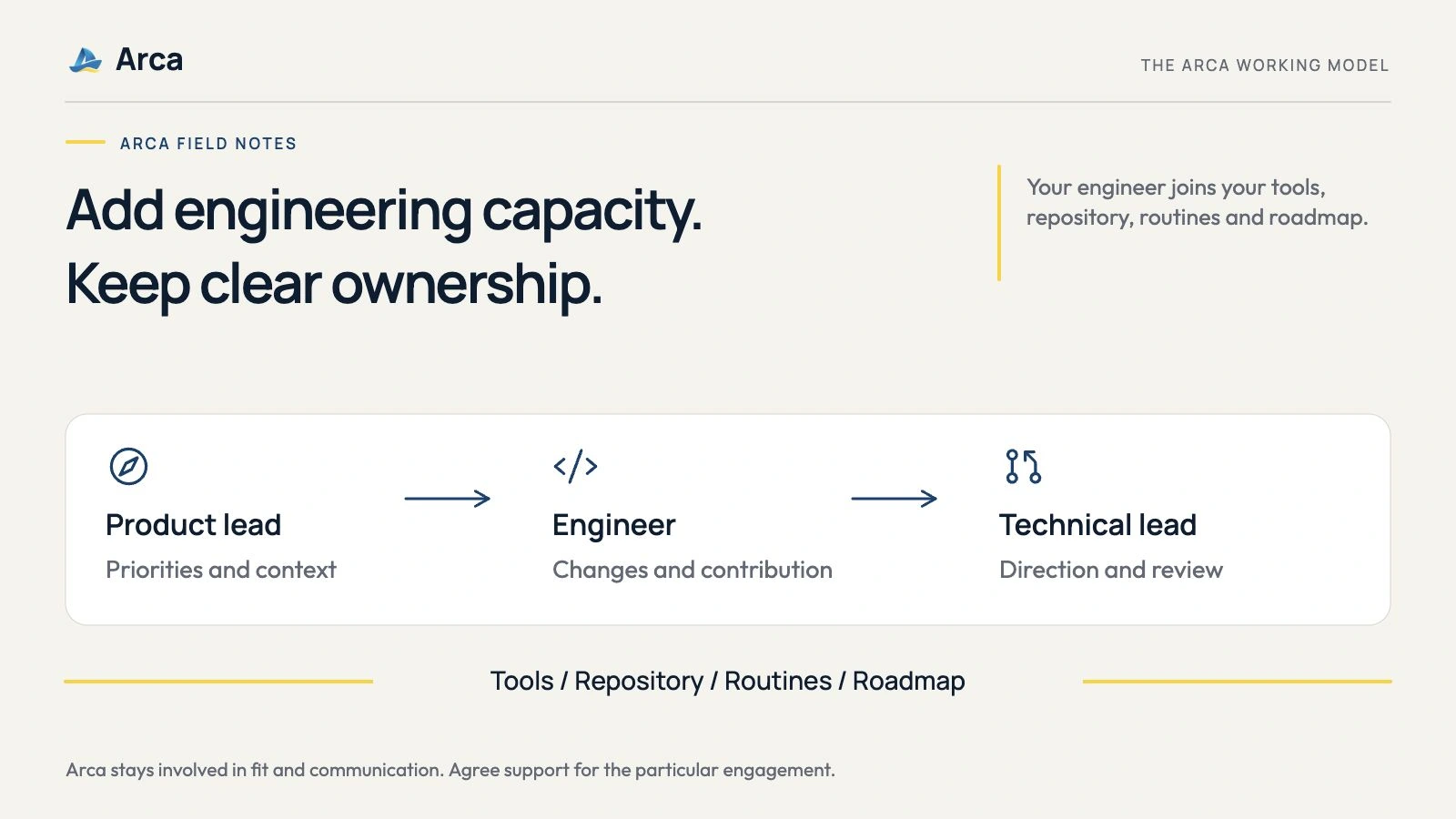
For a small product team, that might mean a shared planning discussion, a written feature brief, and a clear review queue. For a larger team, it may mean joining an established engineering squad. Decide where the new person belongs and give them the context to contribute there.
Use the first-month engineering onboarding plan to prepare access and a reviewer, guide a bounded contribution, and agree the next responsibility with the engineer.
If the hire does not work out
If the developer is not the right fit, you get a free replacement for 3 months. Your product and engineering priorities still belong to your team.
When Arca.ph is a strong fit for your team
Arca.ph fits best when you have meaningful engineering work, someone who can provide technical direction, and a clear reason to add capacity. You may need help owning a product area, strengthening a particular part of the stack, or bringing a defined engineering skill into the team.
You do not need a perfect job description to start. Begin with the problem, the current team, and the decisions you need the new person to handle.
If you are still choosing a hiring approach, our guide to finding and hiring offshore software developers explains sourcing options and includes a role brief you can use.
What it costs
Profiles are free to view. If you hire someone Arca.ph introduced, you pay one fee: 15% of first-year pay, paid once. Salaries are quoted per month, up to about $3,000/mo. You also get a free replacement for 3 months. Your own tools, infrastructure and product leadership still need owners.
Know what you need to build
Prepare the stack, the responsibility, product context, US time zone and intended start. Decide whether you need a founding engineer or an addition to an existing team. Then browse profiles and sort them, or have your AI assistant sort them.
Get started to find the software engineer your team needs next.
Frequently asked questions
How does Arca.ph vet software engineers?
Developers can take optional tests watched by a real person: English screening, thinking skills, a coding test with no AI, and live pair-programming. You see every profile, and your AI assistant sorts them; your team interviews and chooses.
Who directs the day-to-day work of a developer hired through Arca.ph?
The developer joins your tools, repository, routines, and roadmap. Your team directs priorities and provides product context and technical direction. This model suits teams adding engineering capability to the way they already build.
How do we agree working times with a developer?
Agree the schedule with the developer you hire. Specify your named US time zone and working day, record seasonal clock changes and agree any incident coverage outside that day separately.
How much does hiring through Arca.ph cost, and how long does it take?
Profiles are free to view. If you hire someone Arca.ph introduced, you pay one fee of 15% of first-year pay, once. Salaries are quoted per month, up to about $3,000/mo. You see every profile, and your AI assistant sorts them, so the timeline depends on your interviews and the selected developer's start date.
What kinds of engineers can I find on Arca.ph?
Arca.ph lists vetted remote software engineers from around the world. Use each profile's work history to match the person to the responsibility you need filled.
What if the developer is not the right fit?
You get a free replacement for 3 months. Note what was not working so your next search addresses the role and fit.