By Jake Parks
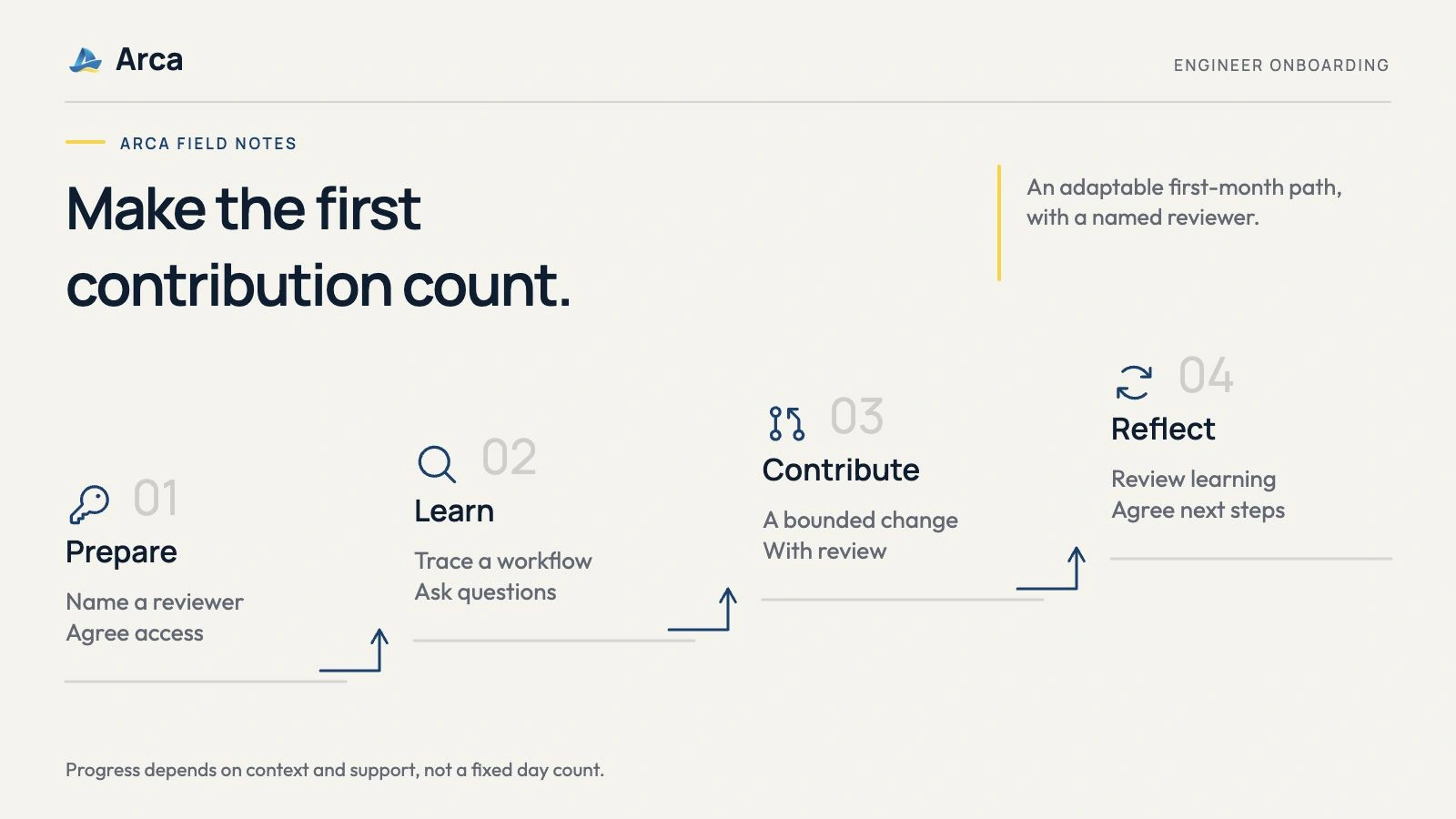
An offshore developer onboarding checklist should help a new engineer make a useful, reviewed contribution in your actual system. Prepare the first assignment, approved access, a working development setup and people who can answer questions. Then use the first month to expand responsibility as understanding grows.
A welcome call and a repository invitation are a beginning. The harder part is making your team's product decisions, review habits and unwritten knowledge accessible to someone joining from another country.
For US teams hiring Philippine engineers, plan that support around the agreed working window. The first-month example below is a proposed framework to adapt to your codebase and role, not a guarantee of productivity by a particular date.
Design the first contribution before the first day
Choose a small real task that takes the engineer through the workflow you want them to learn. It should have a clear user or team benefit, a visible completion condition and an available reviewer. Avoid a task that requires understanding the entire application before anything useful can happen.
Consider a fictional US subscription-software team bringing a Philippine full-stack engineer into an established application. Its first assignment is to improve the empty state on an account-activity page. The engineer needs to understand the component, test data, design expectation and review process. They do not need to redesign billing or receive unrestricted production access.
Write the assignment as a task card:
| Field | Fictional first-assignment example |
|---|---|
| Purpose | Help a new customer understand what to do when no activity exists |
| Scope | Update the existing empty state; leave billing behavior and permissions unchanged |
| Context | Link the component, design example, test fixture and current behavior |
| Completion evidence | Demonstrate empty and populated states, run relevant checks and describe limitations |
| People | Product owner confirms wording; technical reviewer examines the change and tests |
This is an original example, not an Arca client case. A backend hire might need a different starting task, such as improving a synthetic-data test around an existing validation rule. A useful first contribution can also improve a test or a setup instruction; it need not be a production release to demonstrate learning.
Engineering tasks can teach more than the code itself. A 2021 case study of onboarding in software teams, based on Microsoft interviews and surveys, examines learning, confidence and socialization through onboarding tasks. It does not establish a universal ramp-up deadline. Use the task to connect the new engineer with the people and decisions around the work.
Put names beside the first month's support
“The team will help” is difficult to use when several people are offline. Identify the people who can act on different questions:
- Product owner: explains the user problem and accepts product behavior.
- Technical reviewer: explains conventions, examines changes and helps resolve design questions.
- Setup or access owner: resolves development-environment and account problems through approved processes.
- Onboarding buddy: helps the engineer navigate people, routines and ordinary questions.
- Documentation owner: keeps setup instructions and the first-assignment guidance current.
One person may fill several roles in a small company. What matters is that they have time and authority, and that the engineer knows whom to contact. A friendly buddy should not be expected to approve production permissions they do not control.
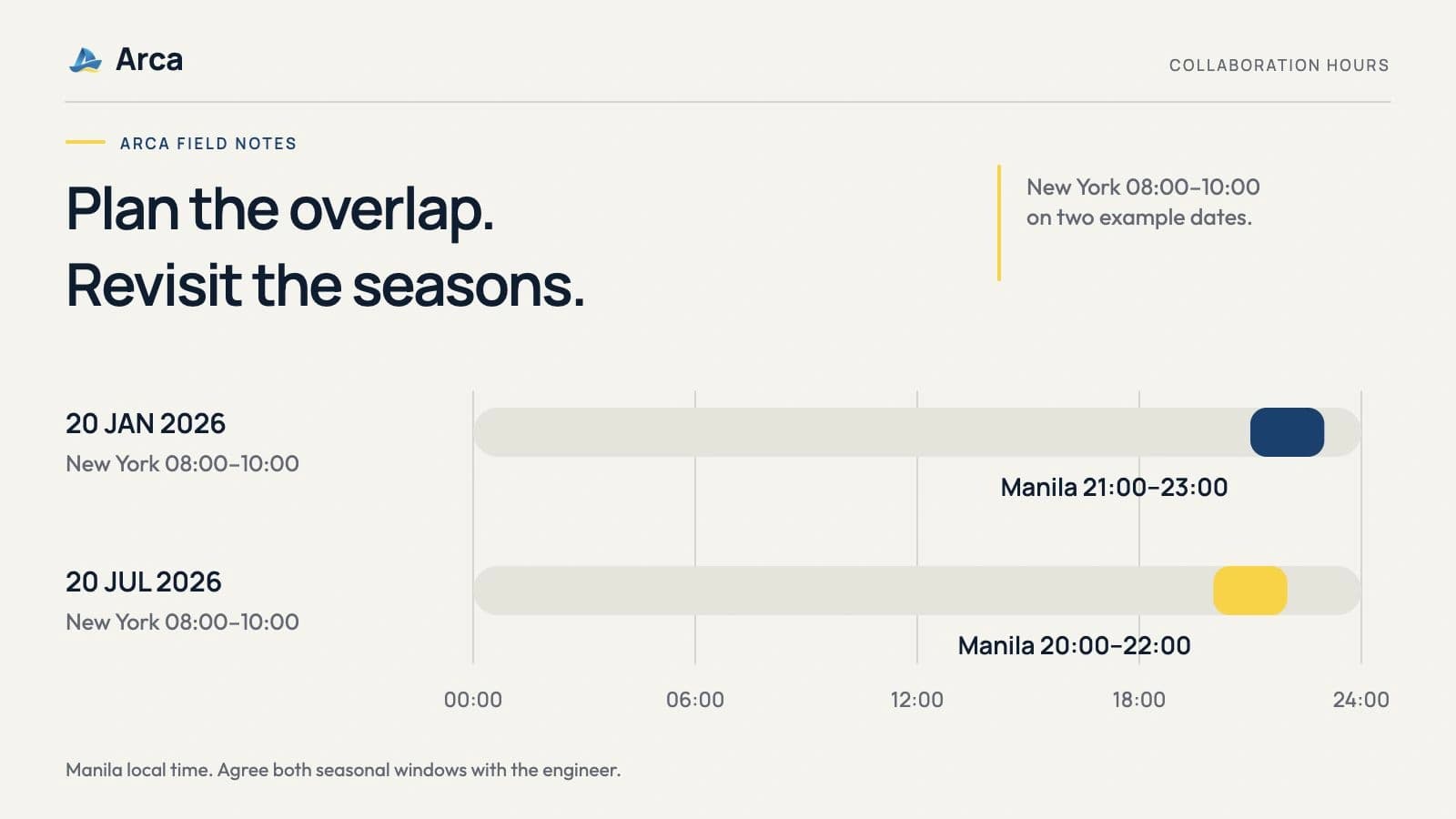
Set review availability within the collaboration arrangement already agreed during hiring. Confirm named time zones and seasonal changes instead of assuming all US mornings map to the same Philippine evening. Written questions should include the context needed for the next working period; urgent production issues follow a separately agreed escalation process.
Use a first-month plan with evidence at each checkpoint
The table is a planning template, not a performance threshold. Move the dates when access, system complexity, role scope or actual learning needs justify it.
| Period | Work to prepare or guide | Evidence to review together |
|---|---|---|
| Before the start | Confirm equipment responsibilities, approved accounts, the task card, named owners and the first week's calendar | Owners acknowledge preparation; invitations follow approved activation timing; no credentials pasted into onboarding documents |
| First working days | Welcome the engineer, trace the relevant product flow, verify local setup and walk through the task | Engineer can explain the purpose, run the agreed checks and identify where questions belong |
| Rest of the first two weeks | Pair where needed, submit the small change and work through technical and product feedback | A reviewed contribution or a documented blocker, plus corrected setup instructions |
| Remaining first month | Expand to a related bounded responsibility and review how collaboration is working | Engineer can explain decisions and limitations, obtain review and identify the support needed for the next assignment |
Keep administrative and engagement obligations with their proper owners. This guide does not allocate payroll, equipment supply, employment or contracting responsibilities to Arca or to a generic hiring model. Confirm those terms for the actual engagement.
Verify the development environment through a shared result
Ask the engineer and setup owner to run a documented check that the team recognizes: load the relevant application area with synthetic data, run an existing test or reproduce the expected local behavior. Record required runtime versions and approved configuration instructions alongside the repository.
Use the project's established toolchain. For a project using npm and a committed lockfile, npm's documentation for npm ci explains its clean-install behavior and that it fails when the dependency manifest and lockfile disagree. That can be useful in a documented setup, but it is not a universal command for every stack and it does not itself secure dependency installation. Follow the repository's reviewed instructions.
If setup fails, capture the command, relevant version, expected result and actual error without exposing secrets. Assign a person to fix the instructions once the cause is understood. Do not leave the next engineer dependent on a private chat thread to reproduce the solution.
Make the first review a learning conversation
Before the engineer submits the first change, explain what the reviewer needs: the problem, the scope, checks completed and any uncertainty. Show an ordinary past review so the person can see your team's expectations in context.
Google's published guidance on small code changes favors self-contained changes that reviewers can understand. Apply that idea to the first assignment rather than setting a line-count target. A tiny change with hidden dependencies can be harder to review than a clear, complete one.
In the fictional empty-state task, the reviewer discovers that another account type has a different first action. The right response is to clarify that product case and adjust the task, not to treat the question as proof that onboarding failed. Keep the question and answer with the work so the next person can find them.
GitLab's communication handbook documents writing down conclusions reached outside the main written discussion. This is a helpful example for a distributed team: a live call can resolve uncertainty, while a short written decision makes that resolution usable later.
Review blockers before judging independence
At the end of each working week, ask the engineer and the responsible lead to examine what happened:
- Which contribution moved forward, and what feedback improved it?
- What waited on a permission, environment fix or business decision?
- Could the engineer find the right person during the agreed working arrangement?
- Which instruction should change before the next assignment?
- What responsibility can expand safely, and what still needs support?
These questions separate learning from missing preparation. A blocked invitation to the required repository is a setup issue; a deliberate production restriction is a boundary to respect. An unclear acceptance condition is a product decision. A misunderstood technical change may call for more explanation, pairing or a narrower task.
Avoid using presence, message volume or raw commit counts as a substitute for that review. Examine the actual work, its quality and the conditions under which it was attempted. A first month should reveal how the engineer and team can work effectively together.
Prepare for the engineer joining through Arca
Arca's Philippine engineering hiring approach starts with your requirements, role-specific screening and a focused shortlist. Your team chooses the engineer and provides the product context and technical direction within its own workflow.
Bring a first-assignment example, the technical reviewer and your proposed collaboration arrangement to the discussion. Ask how fit, communication and support will work for your engagement. A hiring partner's screening helps inform the choice; your own system still needs an owner who can guide the work.
If the responsibility is still unclear, use our guide to choosing a first Philippine engineering role. For the wider search, read how to find and hire offshore developers. Then discuss the role with Arca with enough context to plan a useful beginning.
Frequently asked questions
Should an offshore engineer ship production code on the first day?
There is no universal deadline. Choose a small useful contribution and prepare the setup and review it needs. Completion might be a code change, a test or a documentation improvement. Production release still follows your team's normal approvals; early activity alone does not demonstrate readiness.
Who should own onboarding when we hire through a partner?
Agree the engagement responsibilities with the partner, and name the people in your team who provide product context, technical review and approved access. A hiring partner cannot supply knowledge of your application by assumption. Make each responsibility and escalation route visible before the start.
What if the engineer cannot complete the first assignment on schedule?
Review the evidence with the engineer. Separate missing access, broken setup, unclear product decisions and unavailable reviewers from gaps that need more explanation or practice. Adjust the task or support based on the cause instead of treating every delay as the same performance problem.
Can we reuse the same first-month checklist for every engineering role?
Reuse the preparation and ownership prompts, then change the task, evidence and technical context for the role. A frontend, backend, QA or DevOps engineer needs a relevant first contribution rather than an identical generic coding assignment.
How should the first month end?
Review completed work, feedback, unresolved blockers and the engineer's understanding of decision and review routes. Agree the next bounded responsibility and the support it needs. Independence should follow the actual scope and evidence, not the calendar date alone.