Cover image: AI-generated illustration of fictional people and a fictional workplace; not actual Arca staff or a client.
You want to hire a software engineer in the Philippines. Your roadmap is growing, your current team needs help, and you are ready to speak with candidates.
Then comes the question that shapes the search: which engineer do you need first?
A full-stack developer, a back-end engineer and a DevOps engineer might all know parts of your stack. They would still solve different problems. Choosing a title before identifying the work can leave you interviewing capable people for an unclear job.
At Arca, the hiring conversation starts with your team's requirements. This guide helps you make one decision before that conversation: the responsibility your first Philippine engineering hire should take on. It applies whether you are adding your first offshore teammate or building the engineering function itself.
Look at where the work stops
Start with a recent piece of work that failed to move forward. Describe what happened, who was involved and what was missing.
“We need more developers” could mean several things:
- The product design is ready, but nobody has time to implement the interface.
- Features depend on an API that needs careful data and integration work.
- Releases require repeated manual intervention from the same senior engineer.
- Bugs keep returning because nobody owns a repeatable test approach.
- An AI demonstration works, but the team cannot yet evaluate or operate it reliably.
Those situations suggest different searches. They can also reveal a problem that another hire will not resolve on its own: unclear priorities, unavailable reviewers or decisions that nobody is authorized to make.
The US Office of Personnel Management describes job analysis as examining a job's tasks, the capabilities those tasks require and how the two connect. Apply that approach to your engineering search: describe the work before deciding which credentials to request. Read OPM's job-analysis guidance.
Write a sentence your team can challenge:
“We need this engineer to take responsibility for ___, with support from ___, so that ___.”
If the sentence ends with “everything technical,” narrow it before you start sourcing.
Match the first hire to a responsibility you can explain
Use this table to frame a discussion with your technical lead. These are practical examples, not universal definitions of engineering titles.
| Work that needs an owner | Role to investigate | Evidence worth discussing |
|---|---|---|
| A focused product area needs changes across its interface, API and data layer | Full-stack developer | A feature they carried across those boundaries, including tests and review decisions |
| The interface is the main gap, while API and platform support already exist | Front-end engineer | Usable, accessible interfaces; difficult application states; collaboration with design and API owners |
| Integrations, application rules or data handling need deeper attention | Back-end engineer | Failure handling, data correctness, API design and production troubleshooting |
| Deployment, infrastructure or reliability work keeps interrupting delivery | DevOps or platform engineer; clarify any SRE responsibilities | Repeatable releases, monitoring, incident judgment and sustainable operational ownership |
| Quality problems need a systematic approach across an existing product | QA engineer or software engineer focused on test automation | Risk-based test choices, reproducible failures and collaboration with developers |
| A defined AI capability needs evaluation and integration into a real application | AI engineer or software engineer with the relevant AI experience | Evaluation methods, failure handling, data boundaries and the surrounding application work |
A full-stack developer can be the right choice when the work crosses application layers and the scope is manageable. The title does not promise equal depth in every framework, database, infrastructure tool and AI system.
Likewise, writing “DevOps” in the job description should lead to a clear discussion of responsibilities. Google's SRE book distinguishes lasting engineering improvements from repetitive operational work that grows with a service. Use that distinction to ask which recurring deployment or operations problems the new engineer should help eliminate. Read Google's explanation of operational toil.
For an AI role, name the capability you want to ship. Connecting an existing model to an application, building a data pipeline and developing a model are different assignments. Agree on the work and then look for the relevant experience.
One Philippine hiring search, two different answers
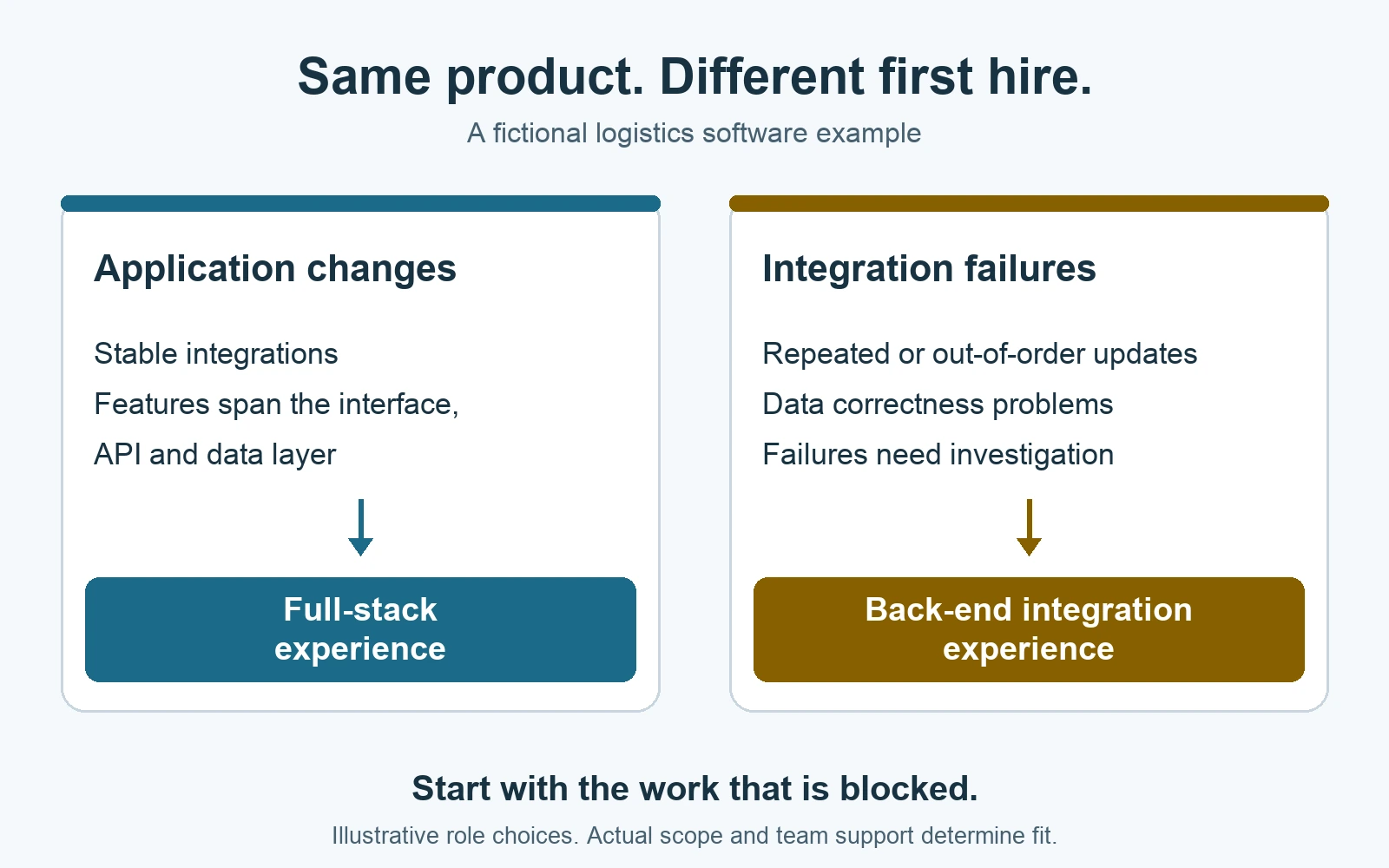
Consider a fictional US logistics software company preparing its first engineering hire in the Philippines. It already has a technical lead in the US. The product receives shipment updates from outside systems, and the founder wants to hire a full-stack developer.
The team reviews the last few delivery problems before opening the role.
If the backlog is application work
The lead finds that the integrations are stable. The main gap is a sequence of small features: showing shipment history, adding a useful filter and improving exception handling in the interface. The lead can review the API changes and help with design decisions.
A full-stack search is reasonable. The responsibility is a bounded product area, with someone available to review the parts that need support. Candidates should be able to explain how they have delivered comparable changes across an application.
If the backlog is an integration problem
Now change one fact. The interface is waiting because incoming updates arrive twice, out of order or not at all. The team needs someone to investigate integration behavior, protect data correctness and make failures diagnosable.
The search should emphasize back-end and integration experience. A candidate who also works on interfaces might fit, but front-end breadth is secondary to the problem the team needs solved.
The location and planned headcount have stayed the same. The responsibility has changed the search.
Before requesting a shortlist, have your technical lead explain which version resembles your situation—and what evidence would change their mind.
Decide how much technical independence the role needs
Seniority should describe the decisions the person will handle and the support you can provide.
A developer joining an established team may have a defined architecture, a manageable queue and regular review. An engineer joining a company without technical leadership faces a different assignment, even if the technology list looks identical.
Ask:
- Who decides product priorities and resolves conflicting requests?
- Who reviews design and code when the new engineer needs another perspective?
- Who approves production changes and handles operational escalation?
- Which decisions should the engineer make independently?
- Which responsibilities remain with the existing team?
NIST's Secure Software Development Framework explicitly calls for defining and maintaining development roles and responsibilities, including security responsibilities. It reinforces the need to name owners; it does not mean one new engineer should become responsible for every security task. See NIST SSDF, practice PO.2.
If you do not have a technical reviewer, make that visible before hiring. You may need leadership or advisory capacity alongside the implementation role. Explain that gap in the hiring conversation so the expected independence and available support are clear.
Make the Philippines collaboration arrangement specific
Choosing Philippine talent is part of the search. The working arrangement still needs to fit the people and the job.
For a US team, identify which decisions need live discussion, the cities or time zones involved and how work continues outside shared hours. Confirm the candidate's actual availability rather than assuming a location guarantees a particular shift.
A front-end engineer working closely with a designer may need a different discussion rhythm from a back-end engineer handling a well-defined integration. A role with production support needs explicit coverage and escalation arrangements; one offshore hire is not automatically a round-the-clock team.
Discuss the proposed engagement, budget, equipment and access requirements too. Keep employment and contractual responsibilities explicit with the appropriate advisers. “Remote,” “offshore” and a job title do not settle those terms.
If you are still deciding who will direct delivery, read our comparison of offshore staff augmentation and project outsourcing. That choice belongs alongside the role decision.
Bring evidence questions into the Arca conversation
Arca matches Philippine software engineers to a team's technical needs and working approach. Its published process covers role-specific assessment and a shortlist, followed by the client's choice of engineer. Use that conversation to explore the responsibility you have identified, including the decisions the person will own and the support your team can provide.
For example, a back-end integration opening might need evidence about handling repeated events, investigating failures and explaining data tradeoffs. A front-end opening might need evidence about interaction states, accessibility and coordinating API changes. The exact questions should follow the actual role.
OPM's structured-interview guidance uses predetermined questions and common evaluation standards to compare job-related capabilities consistently. Apply that principle to your search: agree on the essential evidence before the interviews, rather than moving the criteria after each conversation. Read OPM's structured-interview guidance.
For a practical assessment example, use our guide to interviewing an offshore full-stack developer. For Arca's broader approach, read why teams hire Philippine software engineers through Arca.
Make the next hiring conversation concrete
Before speaking with Arca, prepare a short answer to each of these prompts:
- The work: Which recent delivery problem prompted the hire?
- The responsibility: What should the new engineer take ownership of?
- The support: Who provides product direction, technical review and escalation?
- The evidence: Which relevant experience or decisions should candidates demonstrate?
- The arrangement: What collaboration window, engagement, budget and start expectations need discussion?
You do not need a perfect job description to begin. You need enough context to explain the gap and recognize a useful match.
For the wider sourcing process, start with our guide to finding and hiring offshore software developers.
Frequently asked questions
Should my first Philippine engineering hire be a full-stack developer?
Consider a full-stack developer when the work spans application layers and the scope fits one person's experience. A specialist may be more suitable when the main gap is deeper back-end work, interfaces, infrastructure, testing or AI. Decide from the responsibility and available support, rather than the title alone.
Can I hire through Arca if I do not know the exact job title?
Start by describing the product, the work that is blocked and the support your team can provide. Arca's discovery conversation covers your requirements and next steps. Clarify the role and expected evidence before committing to a search or engagement.
Does hiring an engineer mean outsourcing the whole project?
It depends on the agreement. Adding a person to work within your team differs from commissioning a provider to deliver a defined project. Establish who directs priorities, reviews work, accepts delivery and handles changes before deciding on the arrangement.
What should I ask before accepting an engineer shortlist?
Ask why each person fits the responsibility, what relevant experience or assessment evidence supports that fit, and what remains to be explored with your team. Confirm availability, collaboration expectations and the proposed commercial terms separately.