By Jake Parks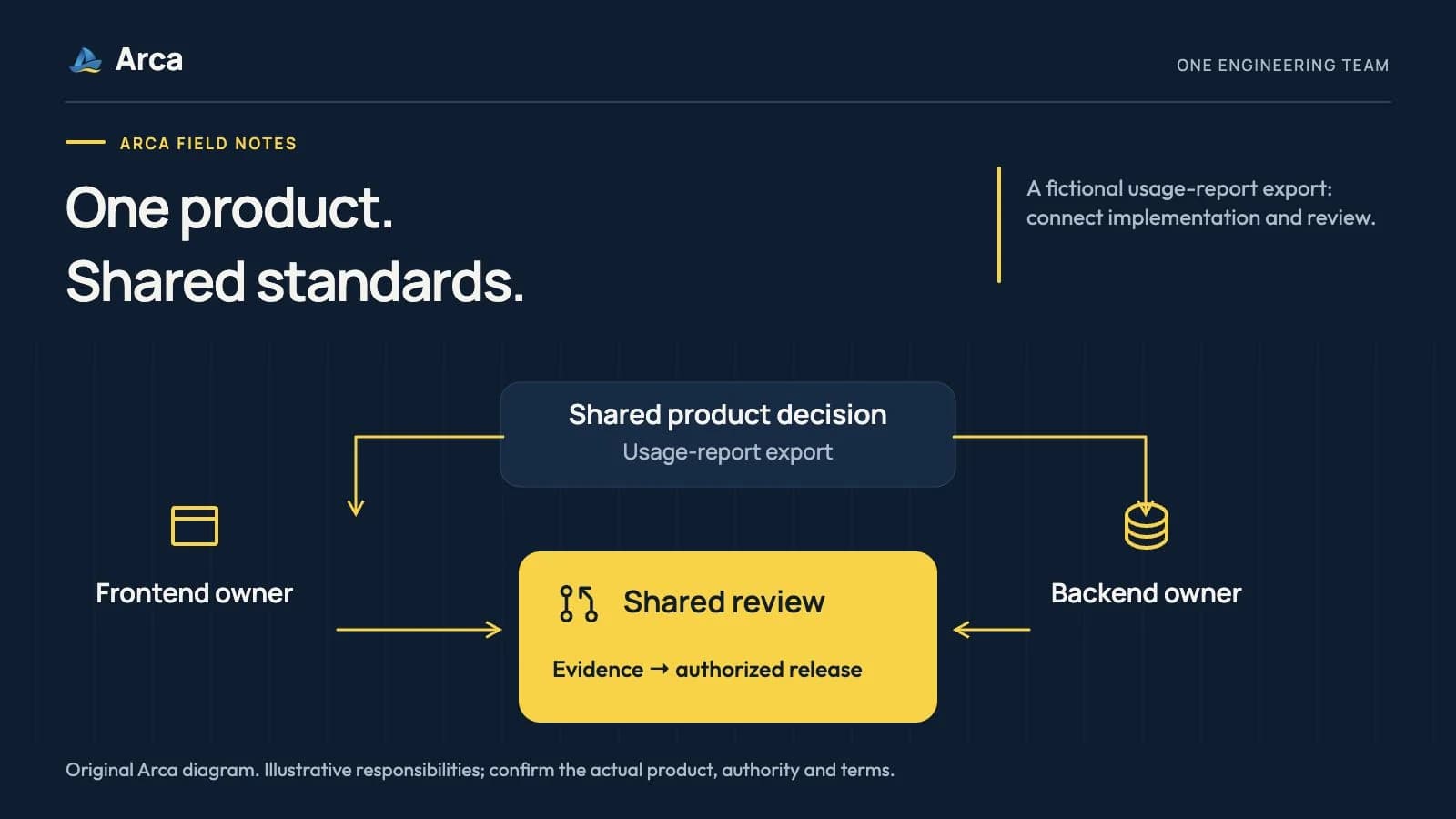
Combining in-house and offshore engineers works best as a team-design decision: define the shared product responsibility, technical standards, review path and decision owners before splitting the work. Geography alone is a poor specification for who may propose, implement or approve a change.
For a US company adding Philippine engineers, the aim is a working system in which the people involved can access the context they need and understand their responsibilities. Adding capacity cannot resolve an unnamed product owner or a review queue nobody has time to handle.
Trace one change through the whole team
Consider a fictional subscription-software business adding a usage-report export. A US product manager owns the customer need. An existing frontend engineer owns the interface. A Philippine backend engineer will work on the export service. A technical lead reviews the change across boundaries.
If the team sends the backend engineer an isolated ticket and discusses important behavior only in the US office, the assignment remains incomplete. The engineer needs the same agreed meaning of account access, report contents and failure states as the rest of the team.
Use a shared work item to connect those decisions. Microsoft's async collaboration checklist supports durable context and recorded decisions. That practice helps distributed work without requiring every conversation to happen at the same time.
Build an ownership map around decisions
The following original map is illustrative. Assign actual people based on competence, authority and availability; do not turn these example locations into a universal division of labor.
| Decision or work | Proposed owner in the example | Collaboration or approval needed |
|---|---|---|
| Which records should the export include? | Product manager | Customer context plus technical input on constraints |
| How should account permissions be enforced? | Named backend owner | Technical lead/security review under the team's process |
| How does the user request and receive an export? | Frontend owner | Agreed API contract and product acceptance |
| Does the whole change meet the engineering standard? | Qualified reviewer | Evidence from both engineers, including boundary behavior |
| Can the release proceed? | Authorized release owner | Specific review outcome, operational checks and recovery plan |
| Who follows up when the workflow fails? | Named service owner and backup | Support route and actual coverage agreement |
GitLab's directly responsible individual guidance illustrates explicit accountability with consultation and additional approvals where needed. Your team can use a small map rather than copying a large company's hierarchy.
Avoid defining “offshore” as permission to implement but never question. Equally, do not assume an offshore engineer has authority to approve architectural or production changes merely because the role is senior. Give each person clear room to contribute and a route to the relevant owner.
Use one engineering standard and a practical review path
Agree expectations for tests, documentation, code review and release evidence across the work. Apply standards to the responsibility and product risk rather than the location of the author.
Google's code-review guidance covers concerns such as design, behavior, tests and complexity. Use relevant subjects to establish what reviewers examine. The same standard still requires qualified people with time to perform the review.
Inspect the queue before adding capacity. If every change waits for one unavailable lead, decide how the team can provide review cover or narrow simultaneous work. Do not solve a staffing bottleneck by granting unreviewed production authority.
In the export example, review the interface and service together where their behavior meets. A successful API test does not show that a user understands an empty result, and a polished interface does not prove that account boundaries are enforced.
Make access fit responsibility
Identify the repository, environment and evidence each person needs. Use individual accounts and the permissions required for the assignment. Geographic location is not, by itself, a security assessment.
GitHub's repository-role guidance recommends matching access to function without granting more than needed. Include contractors, employees and provider-supported staff in the same explicit access process, with the actual legal and security requirements taken into account.
Prepare a documented route for requesting additional access. A developer blocked from the relevant test logs needs a permissions decision, not an instruction to copy somebody else's credentials. Our secure-access guide covers preparation in more detail.
Check the working arrangement with the people involved
Agree practical live windows, written handoffs and response expectations. Account for the actual locations, calendars and availability of both sides. Avoid assuming continuous delivery simply because two time zones are involved.
Make decisions from office conversations visible in the shared record. Invite the engineer doing the work to relevant technical discussions, and capture the outcome for people who cannot attend. Evaluate contribution through the agreed work and evidence rather than physical presence or online status.
At a regular team review, examine one completed change. Where did context go missing? Who waited for a decision? Could another engineer explain the result? Improve the operating arrangement using those observations rather than adding a meeting for every handoff.
Hire into the team you can describe
Bring the product responsibility, current team, review capacity and collaboration arrangement to Arca. Confirm the Philippine engineering profile and actual service scope. Recruitment support does not automatically supply your product owner, architecture authority or release management.
Use the shared hiring brief to describe the missing responsibility and the onboarding guide to prepare a useful first contribution. A connected team begins with work and ownership that everyone involved can understand.
Frequently asked questions
Should work be divided mainly by country?
Assign work by responsibility, expertise, authority and support needs. Geography alone is not a technical specification or capability assessment.
Should offshore engineers follow another code standard?
Apply the relevant engineering standard to the work and product risk. Ensure qualified reviewers have time to apply it consistently.
What if one lead is the review bottleneck?
Inspect the queue, arrange appropriate review cover or narrow simultaneous work. Do not bypass necessary review by granting unexamined production authority.
How do we keep office decisions visible?
Capture operative decisions in the shared work record and include the people implementing the work. Record outcomes for colleagues who cannot attend live discussions.
What should be agreed before adding the next engineer?
Clarify the missing product responsibility, collaborators, review capacity, access, response expectations and actual engagement terms. Adding headcount does not assign unnamed owners.