By Jake Parks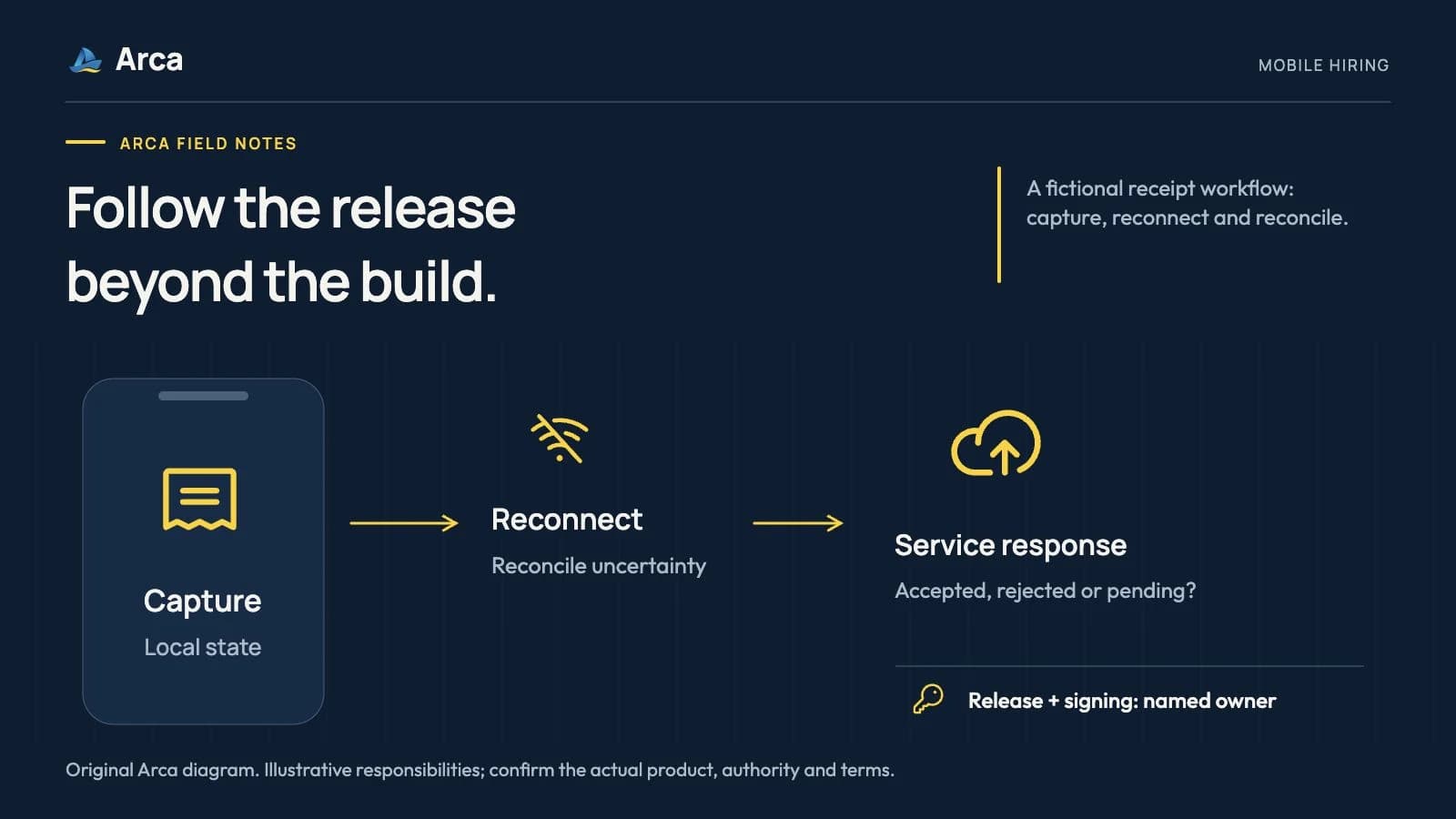
When hiring a mobile app developer, define who will build, test, release and maintain the app—not just which framework they will use. The right profile depends on the existing product, device requirements, backend dependencies and the responsibilities your team can already cover.
For a US company considering Philippine engineering talent, make those boundaries part of the hiring brief. An attractive demonstration does not establish store-release capability, signing-account access or support after users install the app.
Follow a real product action beyond the screen
Consider a fictional field-service receipt app. A technician captures a receipt where connectivity is unreliable, reviews it later and submits it for processing. The interface is only one part of the responsibility. The team must decide what remains on the device, what happens after reconnecting and how a rejected or duplicate submission is handled.
Android's offline-first architecture guidance discusses local and network data, synchronization and conflicts. Use those concerns to investigate relevant mobile experience. It does not mean every app requires the same architecture or a particular conflict-resolution rule.
Ask what devices, operating-system versions and connectivity conditions the product actually supports. An existing iOS codebase creates different entry requirements from a new cross-platform application. Have a technical lead assess the choice; do not assume one framework is always cheaper or suitable for every device capability.
Name the owners across the lifecycle
Use this original worksheet to find gaps before writing the vacancy. It is an illustrative responsibility map, not a promise that one developer covers every function.
| Responsibility | Hiring question | Team support to identify |
|---|---|---|
| Device workflow | Can the engineer reason about receipt capture, interruption and local state? | Product owner, design input and representative test devices |
| Synchronization | How would they investigate uncertain or conflicting submissions? | Backend owner and agreed data semantics |
| Security and privacy | Which receipt data is stored, transmitted and retained? | Security/privacy reviewer and actual product requirements |
| Release preparation | What evidence shows involvement in builds, signing, testing and submission? | Company-controlled accounts, authorized release owner and review process |
| Post-release support | How will failures be detected, investigated and prioritized? | Monitoring, customer-support route and agreed support availability |
| Continuity | Can another engineer build and maintain the agreed version? | Documentation, source access and named receiving owner |
Where responsibilities are shared, record the boundary. The mobile engineer may investigate a failed submission while the backend owner controls the server's duplicate-processing behavior. The product owner decides what the technician should see. Do not treat the job title as authority over all three.
Ask about releases with specific evidence
Discuss one past release the candidate is permitted to describe. What did they personally do? Which checks and approvals were outside their role? What happened after distribution? A public store link can provide context, but it cannot establish who implemented the app or owns its accounts.
Apple's App Review Guidelines include submission completeness, functional behavior and privacy expectations. Store requirements can change; the release owner should check current requirements for the intended distribution route rather than relying on an interview checklist forever.
Google's app-signing documentation distinguishes signing and upload keys in Play App Signing. Ask who controls the relevant accounts and keys, how authorized access is granted and what happens when someone leaves. A developer's ability to produce a local build is different from the company's ability to publish an update.
Keep credentials in approved systems. Do not request a candidate's access to another client's store account as hiring evidence.
Include security in the actual assignment
In the receipt example, discuss what a lost device could expose, how the app authenticates and which data reaches the server. Use synthetic receipts during assessment and avoid collecting unnecessary personal information.
The OWASP Mobile Application Security Verification Standard organizes mobile-security concerns including storage, authentication and network communication. It can inform your security review; naming it in a vacancy does not certify the candidate or application.
Have a qualified reviewer select the controls relevant to the product. If specialized mobile-security expertise is required beyond the proposed developer's role, identify who provides it.
Assess the work without commissioning a free app
A bounded conversation can follow the synthetic receipt through capture, interruption, reconnect and server response. Ask for assumptions, risks, checks and ownership. If an implementation exercise is necessary, agree scope, duration, tools, accessibility arrangements and compensation as appropriate.
Keep platform knowledge and general engineering reasoning visible separately. An engineer may have strong Android release experience and limited iOS experience; that matters differently depending on the work you need now and the support available.
Bring the lifecycle to the hiring discussion
Share the current platform, representative device workflow, release responsibilities and maintenance expectations with Arca. Confirm the profile and actual engagement terms rather than assuming that a mobile placement includes a complete app-development project or indefinite support.
Use the engineering hiring brief to align the role and our secure-access guide to prepare authorized permissions. Mobile hiring becomes clearer when the team can explain how a change reaches users and who owns what happens next.
Frequently asked questions
Should we always hire a cross-platform developer?
No. Match the existing codebase, device capabilities, supported platforms and available team expertise. Have a qualified lead assess the actual trade-offs.
Does a store link prove a candidate built the app?
It provides context, but ask what the candidate personally implemented and which release or support responsibilities they held.
Why discuss signing and account control?
The company needs an authorized path to publish future updates. A local build alone does not establish control of the relevant signing and distribution arrangements.
What should an offline-workflow discussion cover?
Discuss local state, reconnection, uncertain submissions and conflicts using synthetic data. The correct behavior depends on the product and server responsibilities.
Does the MASVS reference certify the application?
No. It supplies mobile-security subjects for a qualified review. Referencing the standard is not verification or certification of the app or candidate.