By Jake Parks
A useful software engineer hiring brief connects the work you need done to the evidence you will assess. It names the product responsibility, current system, decisions the engineer can make, support the team provides and the conditions under which someone can succeed.
For a US company hiring an offshore developer in the Philippines, that document does two jobs. A recruiter can use it to focus the search. Your technical lead can use it to decide whether the shortlisted engineers fit the actual assignment. Both should be working from the same requirements.
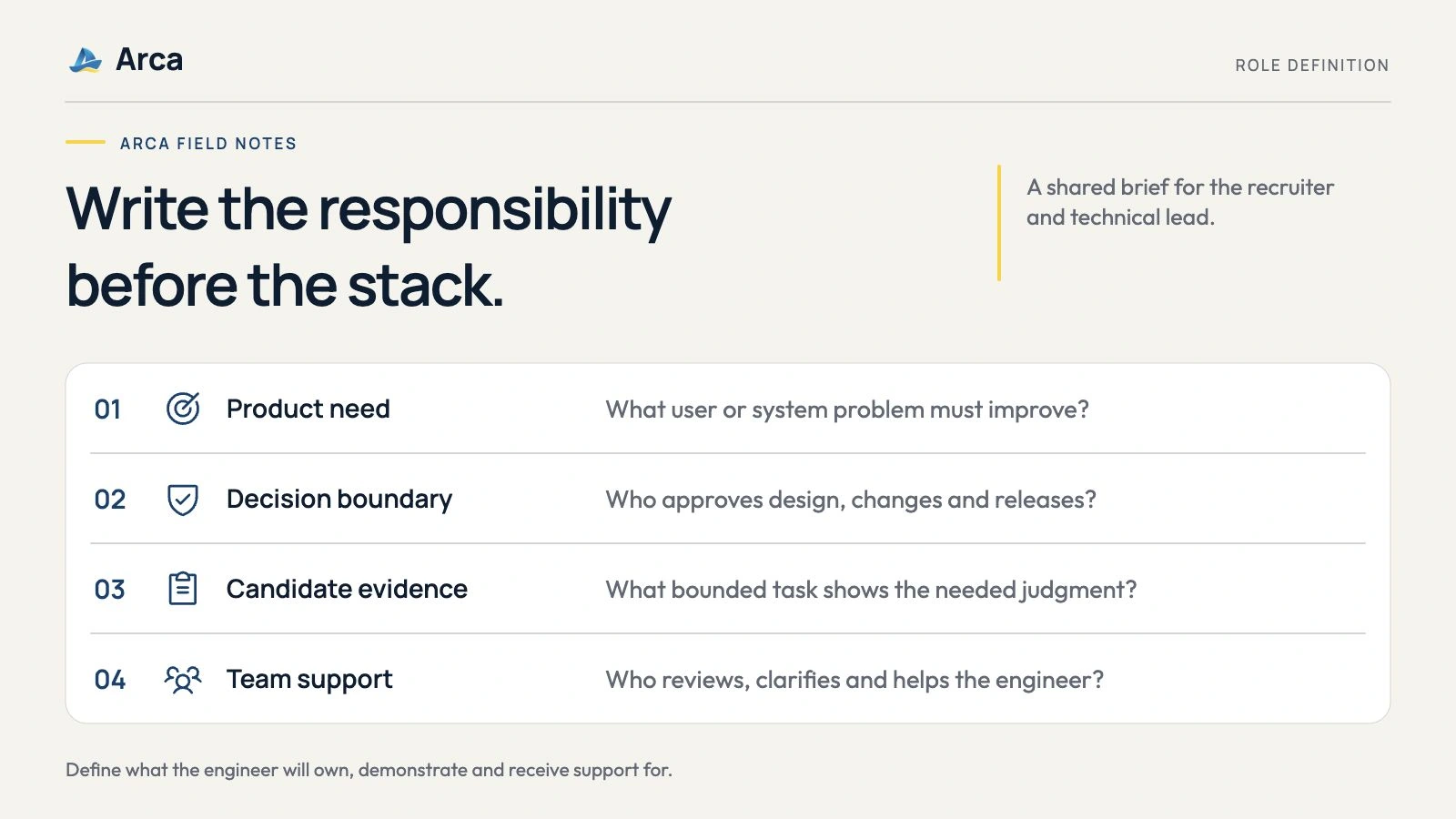
Start with the problem before writing the advertisement. The US Office of Personnel Management's job-analysis guidance connects work tasks with the competencies needed to perform them. Although written for federal hiring, that distinction is useful when turning a software roadmap into a role.
Begin with a recent piece of work
Find an example that represents the responsibility you want to fill. Describe what should happen, what currently prevents it and who can resolve the uncertainty.
“Improve our dashboard” is too broad to guide a search. “Help account managers understand why a report is empty” gives your lead something to examine: the interface, API responses, permissions and the customer consequences of an ambiguous result.
Then ask whether you need implementation capacity, deeper specialist knowledge or technical leadership. Our guide to choosing your first engineering role in the Philippines covers that earlier decision. The hiring brief below records the answer once you have a direction.
A filled software engineer hiring brief
The following is a fictional example, not an Arca client engagement or a promised delivery schedule. A US subscription-software company has a product manager and a senior engineer. It wants a Philippine full-stack engineer to improve account reporting within an existing application.
| Brief field | Example the team can actually discuss |
|---|---|
| Business problem | Account managers cannot tell whether an empty report means no records, an invalid filter or an access problem. |
| Initial responsibility | Improve one reporting workflow across interface and API, including filter behavior, empty states, permissions and useful error messages. |
| Early evidence of progress | A documented state map, a reviewed change addressing an agreed usability gap and tests distinguishing empty, loading and error states. These are proposed checkpoints, not guaranteed dates. |
| Existing system | A React interface, TypeScript API and PostgreSQL database. Provide a diagram and sanitized example payload before technical interviews. |
| Relevant experience | Product changes across interface and API boundaries, with appropriate tests and awareness of data access rules. Explain which stack knowledge is essential on entry and which can be learned. |
| Decision rights | The engineer proposes implementation changes. The senior engineer reviews architecture and production changes; the product manager decides customer-facing behavior. |
| Boundaries | No independent redesign of the entire platform, automatic ownership of all infrastructure or unagreed after-hours support. |
| Collaboration | Written investigation notes plus an agreed live discussion window. Confirm actual time zones and candidate availability. |
| Assessment | Review a synthetic reporting screen and API response, then explain assumptions, state handling, tests and a safe first change. |
| Open commercial questions | Confirm budget, engagement responsibilities, equipment, access and support terms in the proposal. |
The value is in the connections between rows. If the engineer must explain different reporting states, the interview should reveal that judgment. If a senior engineer reviews the work, the vacancy should not imply sole architectural authority.
Keep the brief short enough to discuss together. Link an existing architecture document rather than expanding the hiring document into a complete system specification. Record recurring operational duties separately from the first feature assignment so neither disappears during sourcing.
Separate required capabilities from familiar tools
Use a simple calibration exercise before sending the brief to a recruiter. For each requirement, complete: “We need this because the engineer will have to ___, and we will assess it by ___.”
| Proposed requirement | Calibration question | A more useful formulation |
|---|---|---|
| Expert in every major cloud | Which cloud responsibility will this role actually own? | Experience diagnosing the services used by this application, with help available for unfamiliar infrastructure. |
| Excellent communicator | What communication changes the outcome? | Can explain an uncertain failure, document a decision and ask the product owner a clear question. |
| Five years with our framework | Does tenure establish the needed capability? | Can safely change an existing service and explain relevant tradeoffs; assess framework fluency separately. |
| Comfortable with AI | What use is permitted in the job and interview? | Can disclose tool use, verify generated changes and explain the result in their own reasoning. Building an AI product is a separate capability requirement. |
Keep a requirement only when its absence would materially change your decision. Write useful learning context alongside entry requirements. OPM's work-sample guidance notes that these exercises are most appropriate for competencies candidates are expected to have when joining; they should not quietly test knowledge you intend to teach afterward.
Agree what a safe change involves
A hiring brief needs more than a feature outcome. It should make the surrounding engineering expectations visible.
For the reporting example, the engineer needs to preserve access boundaries, explain data changes, add appropriate tests and leave another developer able to understand the result. Google's code-review guidance examines design, functionality, complexity, tests and documentation. Those are useful prompts for your lead when defining evidence of maintainable work; they are not a ready-made hiring score.
Similarly, NIST's Secure Software Development Framework treats secure practices as part of the development lifecycle. Ask your team to identify the security reviewer and access approver before assuming the new engineer will fill either responsibility alone. Name who acts on assessment and quality findings too; documenting a concern is different from having authority to resolve it.
Use synthetic data during assessment. Agree the scope, duration, permitted tools, accommodation needs and compensation where appropriate before the exercise. A brief should help candidates understand the opportunity, rather than turn the interview into unpaid production work.
Hold one calibration conversation before sourcing
Have the recruiter and technical lead read the brief independently, then answer the same three questions:
- What responsibility will this person own first?
- What evidence would make us confident they can own it?
- What missing capability would make this a different role?
If their answers differ, fix the document before asking for candidates. In the example, a recruiter might initially search for a front-end specialist while the lead expects the person to change API behavior too. Neither needs a longer technology list. They need agreement about which responsibility drives the decision.
Your product owner should also confirm the boundary. “Make reporting clearer” cannot become a guarantee that one engineer will redesign every report. Record dependencies, including who can decide report behavior and explain customer permissions.
Revisit the brief when the work changes. Record why the requirement changed and apply a consistent assessment to candidates still in the process. Avoid redefining the role around the most impressive person you have just interviewed.
Bring the brief to Arca
Arca helps companies hire software engineers in the Philippines, matching the role, stack, experience and working needs with a focused shortlist. Your team chooses the engineer and directs the work within its tools and routines.
You can start without a perfect job advertisement. Bring the example responsibility, current team and unresolved questions to the hiring conversation. A clear brief helps Arca understand the search and helps your lead explain what candidate evidence still matters for your product.
For the broader sourcing process, use our offshore software developer hiring guide. When the brief is ready, our developer interview guide shows how to turn a responsibility into an assessment and a useful hiring debrief.
Frequently asked questions
How is a hiring brief different from a job advertisement?
The brief is the internal agreement about work, constraints, support and assessment. A job advertisement presents the opportunity to candidates. Use the agreed brief as its input, while including accurate compensation and engagement details where appropriate.
Who should approve the software engineer hiring brief?
Include the person responsible for product priorities, the technical lead who can assess the work and the recruiter running the search. Name the final hiring decision owner. Smaller teams may combine these responsibilities, but the decisions still need owners.
Can we approach Arca before the brief is complete?
Yes. Bring the product problem, current system, available team support and the questions you have not resolved. Arca can discuss the role and search requirements; do not treat that conversation as a fixed delivery, price or hiring-time commitment.
Should the brief require every technology in our stack?
Only make a technology an entry requirement when the assigned work depends on it and your team cannot provide the necessary learning support. Separate essential capabilities from useful familiarity and record how you will assess each.
Does hiring offshore change the technical standard?
The standard should follow the responsibility and product risk. An offshore arrangement adds practical questions about collaboration windows, access and escalation; location alone does not establish capability or availability.