By Jake Parks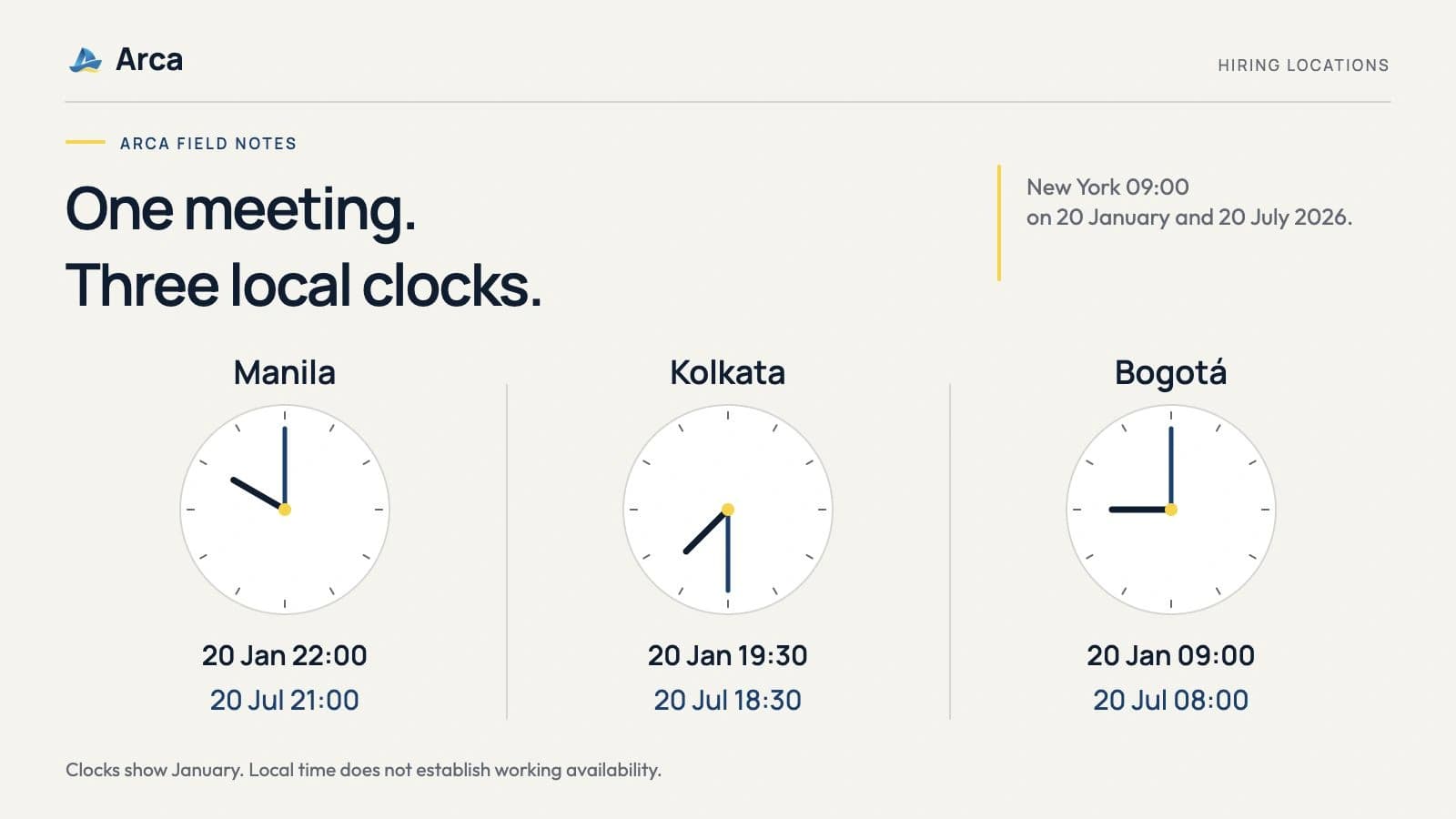
Compare software engineering hiring in the Philippines, India and Colombia against the same role, working window and engagement responsibilities. Start with the constraints your team cannot change, then investigate actual candidates and comparable proposals. A country-wide average cannot tell you which engineer will fit your product.
For a US team, the clock is one observable difference you can calculate before sourcing. Relevant experience, availability, communication and total cost still need evidence from the proposed hire and arrangement. This guide separates those known inputs from the questions your search must answer.
Set the rules before choosing a location
Write down the responsibility you are hiring for and the reason it is difficult to fill. Are you looking for an engineer who can maintain a legacy service, implement reviewed frontend work or lead infrastructure decisions? “A senior developer” is too broad for a meaningful comparison.
Then identify the constraints:
- The live decisions that require shared hours, and the named US time zone.
- The technical experience the person must bring on day one.
- Your team's capacity to review, onboard and explain product context.
- The proposed service and contracting responsibilities.
- The period and inclusions used to compare budgets.
Decide which are requirements and which are preferences. A preference for more overlap should not quietly become a demand for overnight work after an offer has been discussed. If the job itself needs clarification, begin with our guide to choosing an engineering role.
Compare actual local hours, including seasonal changes
The table shows the local time at one illustrative meeting: 09:00 in New York. It uses New York's standard-time and daylight-saving offsets, not a generic “US time.” These are clock conversions, not candidate working schedules.
| Hiring location | When New York is on standard time, UTC−5 | When New York is on daylight time, UTC−4 |
|---|---|---|
| Philippines, Asia/Manila, UTC+8 | 22:00, same calendar day | 21:00, same calendar day |
| India, Asia/Kolkata, UTC+5:30 | 19:30, same calendar day | 18:30, same calendar day |
| Colombia, America/Bogota, UTC−5 | 09:00, same calendar day | 08:00, same calendar day |
The Manila offset is recorded in the IANA time-zone database. India's CSIR-National Physical Laboratory publishes UTC+5:30 for Indian Standard Time, and Colombia's National Metrology Institute publishes UTC−5. NIST's daylight-saving guidance explains the US seasonal change and exceptions. Recheck current rules and use named-zone calendar invitations when arranging real work.
For a New York team needing ordinary daytime collaboration, Bogotá presents a different starting point from Manila or India. That says something about the clock, not about engineering quality. A candidate in Asia may choose an agreed evening or shifted schedule, but you must discuss its feasibility and sustainability rather than assuming it is available.
For a team elsewhere in the US, calculate again using its actual zone. A New York example is not a Los Angeles example, and “nearshore” does not guarantee the hours a particular person will work.
Keep unknown market inputs visible
Use this worksheet while speaking with candidates or providers. Its unconfirmed entries are deliberate. They stop a general country impression from masquerading as evidence about your role.
| Input for the same engineering brief | Philippines proposal | India proposal | Colombia proposal |
|---|---|---|---|
| Relevant candidates available for this responsibility | To verify | To verify | To verify |
| Evidence of the required technical experience | To assess | To assess | To assess |
| Agreed collaboration window in local and US time | To agree | To agree | To agree |
| Comparable price, currency, inclusions and period | Request quote | Request quote | Request quote |
| Internal supervision and review still required | Name owner | Name owner | Name owner |
| Contracting, administration and access responsibilities | Confirm | Confirm | Confirm |
| Continuity and transition arrangements | Confirm | Confirm | Confirm |
Replace each cell with a source and a checked date. If you have explored only one provider, describe its proposal rather than claiming to have measured an entire country's market.
Use an equivalent experience bar across locations. Ask candidates to explain decisions relevant to the work and review comparable evidence. Country population, the size of a broad outsourcing sector or a language ranking does not demonstrate that a particular person can maintain your application.
Work through one fictional hiring decision
Imagine a fictional New York product team that needs an engineer to maintain an existing API. It has a technical lead, documented priorities and a preference for two live working sessions each week. Most implementation and review can happen asynchronously.
The team could investigate all three locations. A Philippine or Indian candidate with the right experience and an agreed working window may fit well; a Colombian candidate may offer easier alignment with daytime sessions. The team should compare the actual proposals rather than eliminate candidates using a national generalization.
Now change one assumption: the role must join frequent, unpredictable customer calls throughout New York business hours. Clock alignment becomes a much stronger requirement. The team might prioritize a naturally overlapping schedule or explicitly source people who want and can sustain the required shift. That change should be made before recruiting, with its implications discussed openly.
Change another assumption: there is no technical lead available. None of the three locations solves that absence. The company must assign leadership, hire for a leadership responsibility or evaluate a different delivery arrangement. Geography cannot substitute for a missing owner.
Compare costs without mixing different purchases
Ask for proposals against the same work, seniority, working needs and planning period. Record whether a number is compensation, a recruitment fee, a continuing service invoice or a project price. A low salary figure and an inclusive service quote cannot be compared directly.
Include your own interview, onboarding, technical review and transition effort. Ask who provides devices, tools and employment administration, and have appropriate reviewers resolve cross-border arrangements. Do not apply a generic benefit percentage or minimum wage to an experienced engineering role.
If an important input remains unknown, run an explicit scenario or request clarification. Do not borrow one country's support-role rates to estimate software engineers in another. A transparent incomplete comparison is more useful than a precise-looking national league table assembled from incompatible figures.
Make a shortlist decision you can explain
Choose a primary search location based on the constraints you have verified. Keep a second route when it addresses a specific unresolved problem, such as limited availability for a specialist role. Write down why you chose it and what evidence would cause you to reconsider.
You do not need to prove that one country is universally better. You need a location and hiring arrangement that can produce relevant, interested candidates whom your team can assess and support.
Arca specializes in helping companies find and assess software engineers in the Philippines. Our role is to match candidates to your responsibility, stack and team requirements, with your team making the hiring decision and directing priorities. If the Philippines is a plausible fit for your constraints, bring this worksheet to a discovery conversation and ask us to test the assumptions for your actual role.
For the next steps beyond choosing a location, see our offshore software developer hiring guide.
Frequently asked questions
Which country has the cheapest software engineers?
This guide does not establish a country-wide price ranking. Request comparable proposals for the same experience, responsibility, schedule, inclusions and planning period, and keep unknown inputs visible.
Can we treat Colombia as representative of all Latin America?
No. Name the country, working location and actual time zone. A regional label does not establish local rules, candidate availability or a shared schedule.
Is Bogotá always on exactly the same clock as New York?
No. Colombia uses UTC−5. New York uses UTC−5 during standard time and UTC−4 during daylight time under current rules, so their local clock relationship changes seasonally.
What should we do if none of the locations supplies a suitable shortlist?
Review whether the role, budget and availability requirements are realistic and clearly stated. Revisit a specific constraint before expanding channels or geography; do not lower the evidence bar simply to complete a comparison.
Does Arca recruit engineering talent in India or Colombia?
Arca's public focus is software engineering talent in the Philippines. This article compares buyer decisions across locations; it is not a claim that Arca supplies candidates in every country discussed.