By Jake Parks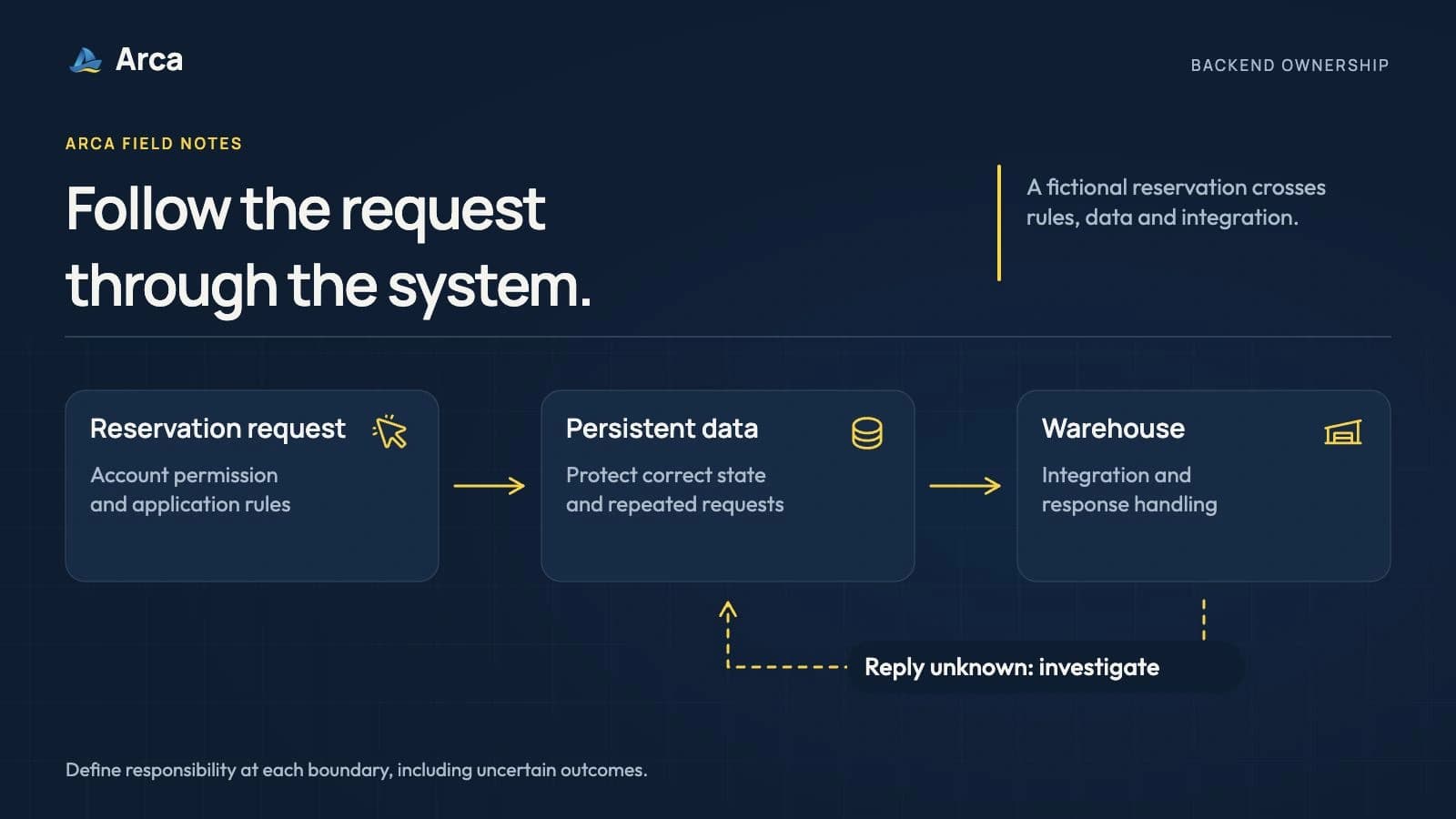
A backend engineer builds and maintains the application behavior behind your interface: APIs, business rules, stored data and connections to other systems. The hiring decision becomes clearer when you specify which of those responsibilities needs an owner, what can go wrong and who supports production changes.
For a US company hiring a backend engineer in the Philippines, language experience matters. So does the ability to protect a customer's records, investigate a failed integration and leave changes another engineer can maintain. A list of frameworks cannot establish those capabilities on its own.
Before opening the role, walk through one important transaction in your product. The example below turns that walkthrough into a practical responsibility map and candidate discussion.
Follow one request all the way through
Imagine a fictional US equipment-rental application. An account manager reserves an item, the application records the reservation and a warehouse system receives an update. Sometimes the application times out waiting for the warehouse response even though the message was received. A retry can then create a second reservation.
The company initially asks for “a Node.js developer.” That describes part of the stack. It leaves several hiring questions unresolved:
- Who establishes whether a reservation is valid?
- What prevents two requests from reserving the same item?
- What happens if the warehouse accepts a message but the application never receives confirmation?
- Who can investigate a customer's report without exposing another account's information?
- Who approves the eventual change and checks that it behaves correctly?
These questions point to backend responsibilities: business logic, data consistency, integration behavior, access control and diagnosis. They also identify work that remains with product, infrastructure and security owners.
If you are still choosing between a generalist and a specialist, begin with our first engineering hire guide. This article assumes backend depth is the gap and helps you specify it.
Build a responsibility map before a technology list
Use the following map as an original working template. The boundaries should reflect your system; they are not universal definitions of a backend job.
| Responsibility | What the backend engineer may own | Evidence to explore | Team boundary to agree |
|---|---|---|---|
| Application rules | Valid reservation states and transitions | Explains conflicting requests and invalid changes | Product owner decides the business policy |
| Persistent data | Schema changes, constraints and migration approach | Shows how a change preserves existing records | Named reviewer approves high-risk changes |
| APIs and permissions | Request validation and access to the correct account's resources | Reasons through an unauthorized request | Security review and access approval remain explicit |
| External integrations | Timeouts, retries, duplicates and reconciliation | Describes uncertain outcomes without assuming every retry is safe | Integration partner behavior and access limits must be confirmed |
| Production diagnosis | Relevant diagnostic signals and investigation notes | Connects a report to evidence and a bounded hypothesis | Infrastructure and incident escalation have named owners |
| Ongoing maintenance | Tests, documentation and understandable implementation | Explains how another engineer will change the feature | Review capacity is planned; adding QA does not remove developer testing responsibility |
For relational data, ask candidates which rules belong in the database as well as application code. PostgreSQL's constraint documentation explains mechanisms including unique constraints, primary keys and foreign keys. Those mechanisms can enforce specific data rules; they do not automatically solve the rental application's entire cross-system transaction.
Likewise, a successful login is only the start of API access control. OWASP's object-level authorization guidance explains why endpoints acting on an object need to check the user's permission for that object. In this example, an account manager must not gain access to another company's reservation by changing an identifier.
Decide how much operational ownership is included
“Own the backend” can hide several jobs. Does it mean changing one service within established infrastructure, maintaining the database as well, or carrying responsibility for incidents? Make the answer visible before interviewing.
A backend engineer may instrument application behavior while a platform engineer maintains the telemetry pipeline. Fixing a reservation rule belongs to application work; making the release path repeatable is a separate delivery responsibility, even when one person contributes to both. OpenTelemetry's signal documentation distinguishes traces, metrics and logs. Use those categories to discuss what evidence the engineer would need to investigate a reservation failure. There is no requirement to introduce a particular observability product just because it appears in a job description.
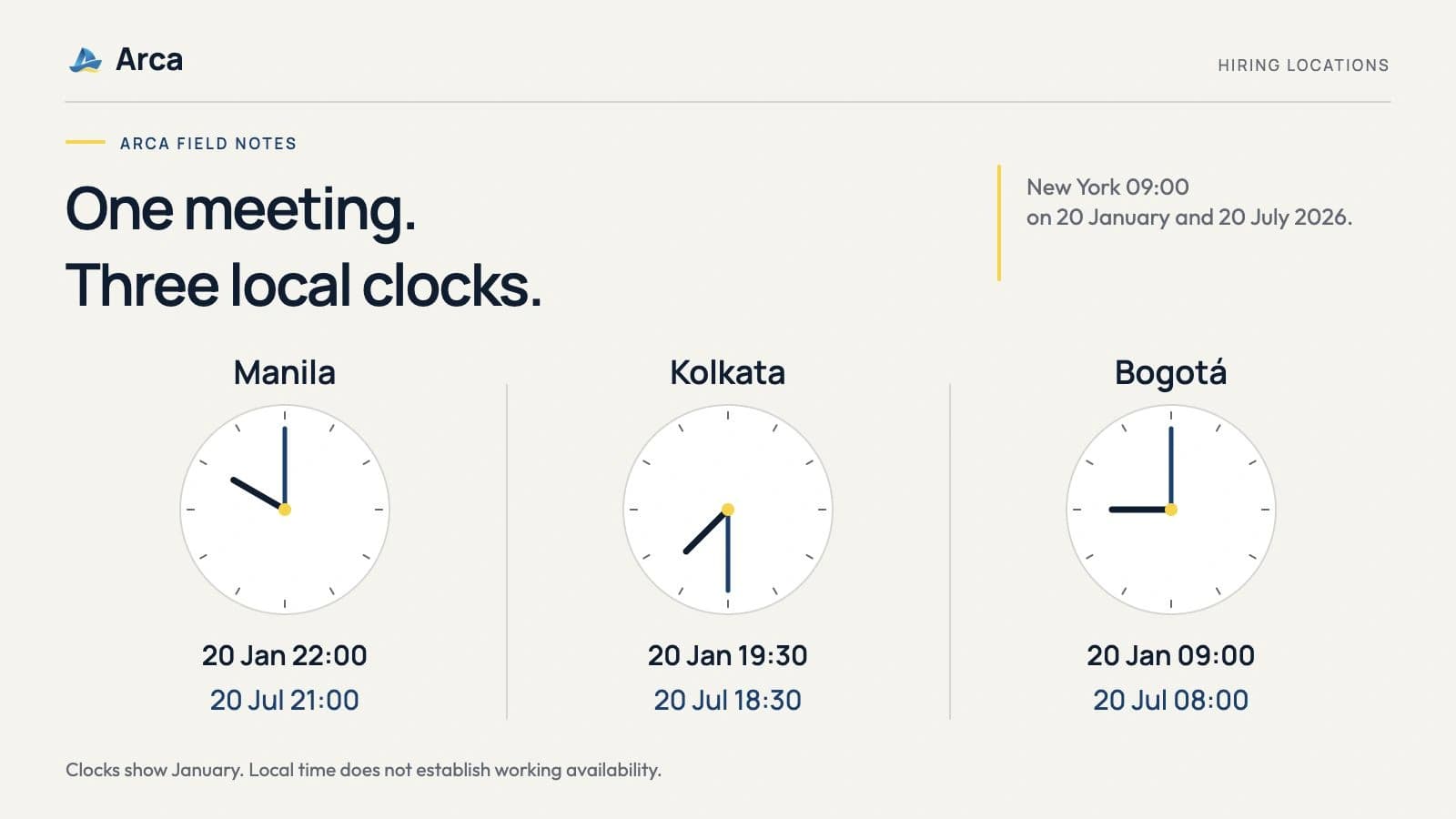
State the support arrangement separately. A Philippine location does not establish a night shift, a US collaboration window or round-the-clock coverage. Agree the candidate's actual working hours, who receives an urgent report and which changes require another person's approval.
Do the same for architecture. Maintaining a well-understood application and separating a service from a complex distributed system are different assignments. Request experience with the architecture you operate and the decisions the new hire must make. Do not add microservices, Kubernetes or several cloud platforms to the requirements unless the responsibility justifies them.
Assess judgment with a bounded failure scenario
Give the candidate a synthetic description of the rental workflow, a simplified API contract and a small set of example events. Explain the business rule: one item cannot be reserved by two customers for the same interval. Ask them to describe a safe investigation and proposed change.
Useful evidence includes whether they:
- Identify missing information before choosing a solution, including what the warehouse guarantees.
- Separate local data correctness from delivery to the external system.
- Consider repeated, concurrent and partially completed requests.
- Describe authorization checks and appropriate diagnostic information.
- Explain tests, release risks and the person who should review the change.
A strong discussion may involve a database transaction, a stable request identifier or a reconciliation mechanism. The right design depends on the constraints. Reward a candidate who makes those dependencies explicit rather than naming every pattern they know.
AWS's reliability testing guidance includes validating functional and non-functional requirements and exercising failure behavior. The hiring application is straightforward: ask what should be tested when a dependency times out, rather than treating a successful demonstration as complete evidence.
Agree the duration, permitted tools and expected deliverable in advance. Use a paid, bounded exercise when appropriate; do not ask candidates to repair an actual customer issue during selection. For a complete interview and debrief process, see our offshore developer interview guide.
Turn the map into a backend hiring conversation
For the fictional application, a concise role request would be:
We need a backend engineer to improve the reservation workflow in an existing Node.js and PostgreSQL application. The role includes data correctness, external integration behavior, tests and investigation notes. Our product owner defines reservation rules; our senior engineer reviews design and production changes. We will agree collaboration and support expectations before hiring.
That request is specific enough to guide a search while leaving room for technical discovery. It does not promise a rewrite or assign every operational responsibility to one person.
Arca matches backend and other software engineers in the Philippines to the role, stack and working needs of your team. Bring your system map, a recent failure example and the decisions this person should own. Arca can discuss the search and introduce relevant candidates; your team makes the hiring decision and directs the work.
If your need is a provider managing a separate finished project, clarify that alongside the role. Our comparison of staff augmentation and project outsourcing explains why staffing an engineer and commissioning an outcome create different responsibilities.
Frequently asked questions
Does a backend engineer need to own our cloud infrastructure?
Only when that responsibility is explicitly part of the role. Agree the division between application behavior, database work, deployment infrastructure and incident response, along with the reviewers and escalation support available.
Should we require experience with our exact backend framework?
Consider how quickly the person must operate independently and how much learning support exists. Relevant fundamentals and production judgment matter, but entry-level framework fluency can still be important for a role that has little ramp-up support.
Can a full-stack developer fill this role?
Possibly, if they demonstrate the backend depth required by your data, integrations and failure risks. Evaluate that evidence rather than assuming a full-stack title guarantees the needed specialization.
Does hiring a Philippine backend engineer provide US-hours support?
Availability must be agreed with the candidate and engagement. Specify time zones, collaboration needs, urgent escalation and coverage; geography does not establish a shift or continuous support.
How can Arca help with a backend search?
Share the stack, system context and responsibilities with Arca. Its public process covers role-specific screening and matching Philippine engineers to your needs, followed by your choice of engineer. Confirm the proposed engagement terms directly.