By Jake Parks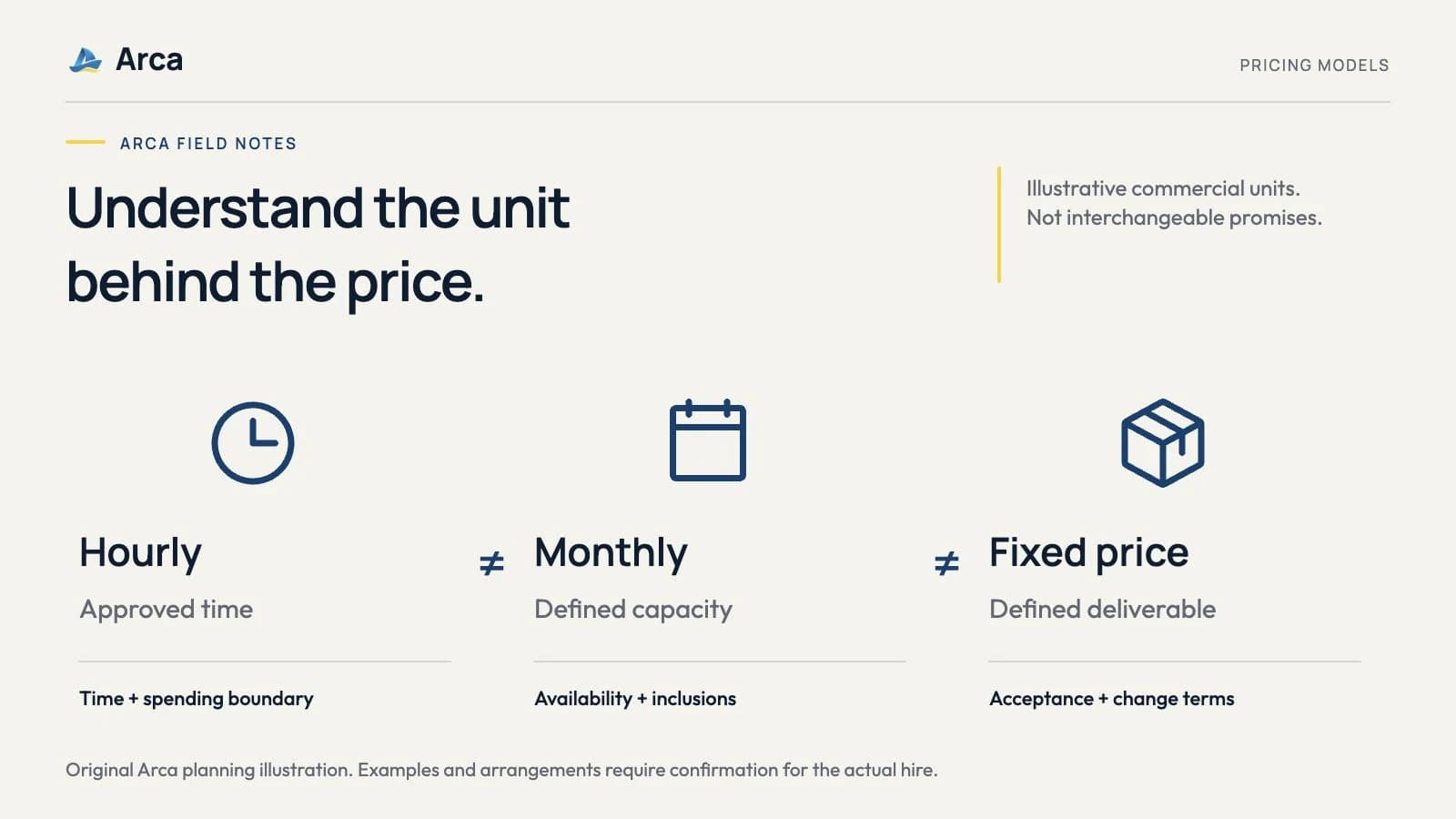
Developer pricing models describe what you pay for and how changes affect the bill. Hourly work, monthly capacity and a fixed-price deliverable can all be reasonable arrangements, but they do not purchase the same promise. Compare scope, responsibility, included capacity and change terms before comparing the headline amounts.
For a US company considering Philippine engineers, keep the invoice model separate from the worker's legal status and the delivery model. A monthly invoice does not by itself establish employment, dedicated availability or a fixed product outcome.
Identify the unit you are buying
Start by asking the provider to describe the billable unit in plain language. Is it approved time, reserved capacity or an accepted deliverable? Then ask what happens when the work changes.
| Model | Unit to confirm | Question that changes the comparison |
|---|---|---|
| Hourly | Approved billable hours at an agreed rate | Which activities count, who approves time and what spending limit applies? |
| Monthly capacity or retainer | The exact availability, hours or service commitment stated in the agreement | What happens to unused capacity, holidays, absence and additional work? |
| Fixed-price deliverable | Defined scope and acceptance conditions for an agreed price | Which assumptions, exclusions and change process can alter the agreement? |
These are commercial questions, not universal definitions that override a contract. US federal procurement rules provide precise examples of firm-fixed-price and time-and-materials arrangements. Their rules govern their own procurement context; use the distinction between priced output and priced inputs as an illustration, not as law governing a private Arca engagement.
Put one piece of work through each model
Imagine a fictional customer-notification improvement. The team needs an investigation, implementation and review, but has not yet established whether the existing messaging service supports the intended behavior.
The following USD figures are invented arithmetic examples, not market rates, an Arca quote or comparable supplier offers.
| Example proposal | Stated arithmetic | What still needs clarification |
|---|---|---|
| Hourly | 80 approved hours × $50 = $4,000 | Whether investigation, review and rework are inside the allowance; what happens at the limit |
| Monthly capacity | $5,000 for a specified month of agreed capacity | Exact availability, other responsibilities and whether this improvement is the only priority |
| Fixed price | $4,500 for the defined improvement | What behavior is accepted, which integration assumptions apply and how changes are priced |
At 110 approved hours, the fictional hourly bill becomes $5,500. The monthly proposal still does not establish that the feature will finish within the month. The fixed-price proposal still depends on what its scope and change terms actually say. Comparing $4,000, $5,000 and $4,500 as if they were the same finished product would hide those differences.
Do not turn this example into a ranking. Resolve the integration uncertainty and compare the actual responsibilities, including who supplies product decisions and technical review.
Compare the full commitment
Request the same list of inclusions from each proposed arrangement: recruiting or setup charges, tools, equipment, taxes where applicable, internal review time, support, notice and transition obligations. Ask which items are included, excluded or still unconfirmed. Do not add a cost twice when it is already bundled in the invoice.
The UK Cabinet Office's Sourcing Playbook discusses whole-life cost and the connection between pricing and risk allocation. It is public-sector guidance, but it supplies a useful planning question: what does the arrangement cost to operate and conclude, beyond its initial price?
Our engineering hiring budget guide owns the broader cost worksheet. Use this article to understand the invoice and scope model before adding those costs to the budget.
Make uncertainty visible before approving spend
Write the assumptions next to the estimate. In the notification example, note who will confirm messaging-service behavior, how that affects scope and what decision follows if the assumption fails.
The US GAO's cost-estimating guide describes scope, assumptions, sensitivity and updates with actual costs. Apply that discipline at a suitable scale: a one-page explanation may be enough for a small engagement. Do not present an uncertain allowance as a precise prediction.
For hourly work, agree time approval, a spending boundary and early warning before the allowance is exhausted. For monthly capacity, agree prioritization and how changing demand affects the commitment. For a fixed deliverable, agree acceptance and change control before implementation starts.
In every model, name the person who can approve additional spend. An engineer's report that a problem is larger than expected is evidence for a decision; it is not automatically permission to increase the bill.
Ask Arca about the actual arrangement
Bring the expected work, continuity needs and unresolved scope to Arca. Confirm available engagement options, inclusions and current terms directly. Do not infer prices, guarantees or fixed-project delivery from this explanatory comparison.
If the team needs a continuing engineer it will direct, compare that requirement with a supplier taking responsibility for a defined output. Our staff augmentation versus project outsourcing guide covers that earlier delivery-model choice. The right pricing discussion follows the work and responsibility you have agreed.
Frequently asked questions
Does a monthly invoice guarantee a finished feature?
Only the actual agreement establishes the commitment. Monthly capacity and a defined deliverable are different units and should not be assumed interchangeable.
Are the dollar figures Arca rates?
No. They are fictional arithmetic inputs showing why offers with different scope and commitments cannot be ranked by headline price alone.
What should an hourly agreement clarify?
Clarify billable activities, time approval, spending limits, included costs and the process for agreeing additional work.
Can a fixed-price project change in cost?
Read its scope, exclusions, acceptance and change terms. A headline fixed price alone does not explain every possible contractual change.
Does the pricing model determine worker classification?
No. Establish legal status and responsibilities from the actual relationship and applicable rules with qualified advice. Invoice frequency alone does not decide them.