By Jake Parks
Hiring an offshore software engineer has two budgets: the money you pay out and the capacity your own team commits. A useful estimate shows both over the same period, then records what the quote includes. A monthly invoice alone cannot tell you whether you can afford the hire.
For a US company considering an engineer in the Philippines, start with the role, intended working arrangement and first six months of work. Then ask for a quote against those assumptions. This guide provides a worksheet for that conversation; it does not publish an Arca rate card or a country salary benchmark.
Decide what the budget is buying
“A developer for six months” leaves important questions unanswered. Is the person maintaining a production service, building a bounded integration or taking ownership of a product area? Who reviews their changes? Does the proposed price cover recruitment only, a continuing staffing service or separately managed delivery?
Write a short scope before entering prices. Use the same brief when sourcing candidates and when asking providers for a quote:
Illustrative brief: One backend engineer to extend an existing API, improve automated tests and maintain the integration afterward. Our engineering lead owns architecture and release approval. We need an agreed collaboration window with our US team. The initial planning period is six months.
This is a fictional role, not a customer example. Its purpose is to make two quotes comparable. A specialist engaged for a migration and an engineer joining a continuing team might be sensible purchases, but their costs answer different questions. Our guide to staff augmentation and project outsourcing explains that distinction.
The US Government Accountability Office's cost-estimating guide emphasizes scope, assumptions, documented inputs and sensitivity analysis. You do not need a government-scale estimating process to apply those principles: state what is being estimated and keep the assumptions beside the numbers.
Use a worksheet with an owner for every line
Copy this table into a spreadsheet. Put zero only where someone has confirmed that no additional cost applies; leave an unconfirmed amount marked “pending.”
| Budget line | What to establish | Who supplies the input? |
|---|---|---|
| Engineer or service payment | Monthly, hourly or milestone basis; currency; planned quantity | Proposed provider or hiring owner |
| Recruitment and provider fees | Included, separately payable or triggered by a later event | Provider and finance |
| Employment administration | Which party handles applicable payroll, benefits and other obligations; what the quote includes | Contracting owner with appropriate advice |
| Equipment and secure setup | Device, delivery, configuration, ownership and return | IT and provider |
| Tools and infrastructure | Incremental seats, test environments and approved AI tools | Engineering and IT |
| Internal hiring time | Interview preparation, assessment and debrief | Interview panel |
| Technical leadership and ramp-up | Review time, onboarding help and product context | Engineering lead |
| Continuity and change | Handover, approved extra capacity, notice and transition costs | Engineering, finance and provider |
| Reserve | Named uncertainty, approval owner and review date | Budget owner |
Check bundled lines carefully. If the service payment already covers equipment, do not add the same device again. If a fee is annual, do not treat it as monthly. If you are comparing an employment proposal with a service proposal, show their actual responsibilities rather than applying the same generic markup to both.
Salary and total employment compensation are also different measures. The Bureau of Labor Statistics' compensation definitions distinguish wages from employer-paid benefits. That is a useful distinction for a US comparison; US benefit data is not a multiplier for employing someone in the Philippines.
A worked six-month example
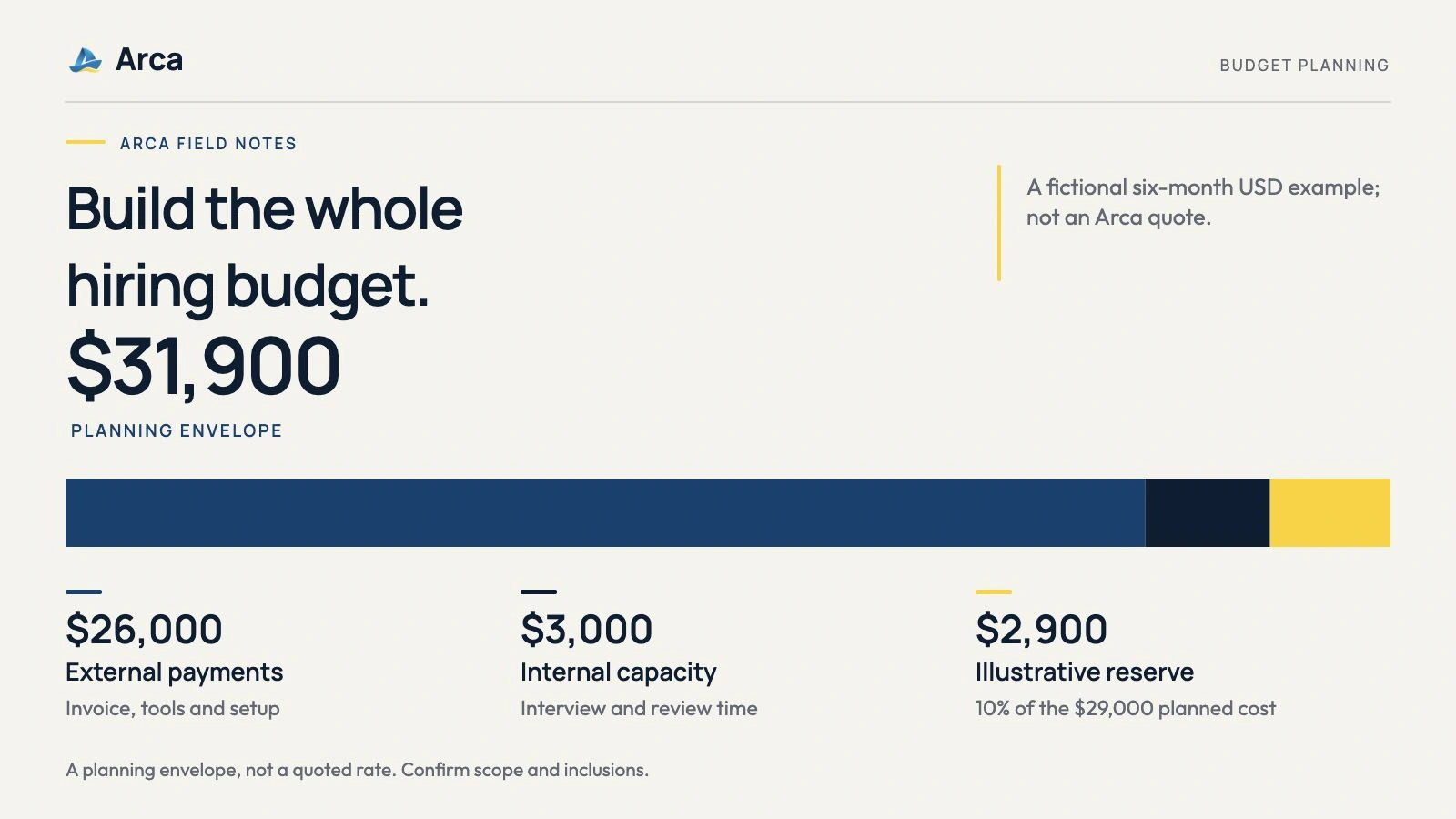
The following USD amounts are invented solely to demonstrate the worksheet. They are not market rates, an Arca quote or evidence of expected savings. The example assumes a proposed service invoice that already includes the provider's fee and employment administration. Those inclusions would need confirmation in a real quote.
| Item | Assumption | Six-month planning amount |
|---|---|---|
| Proposed service invoice | $4,000 each month | $24,000 |
| Incremental software and environments | $100 each month | $600 |
| Equipment and setup | One payment | $1,400 |
| Internal interview effort | 6 hours at an internal planning value of $100/hour | $600 |
| Internal review and onboarding effort | 4 hours each month at the same planning value | $2,400 |
| Planned cost before reserve | External payments plus allocated internal time | $29,000 |
| Illustrative reserve | 10% of the planned cost; an assumption, not a recommended universal percentage | $2,900 |
| Planning envelope including reserve | Reserve is available if approved, not already spent | $31,900 |
The expected external payments are $26,000. The remaining $3,000 before reserve represents existing staff capacity allocated to the hire. That capacity is economically relevant, but it is not an extra provider invoice. Your finance team may report it differently; keep the distinction visible.
Notice the deliberate weakness in the example: four lead hours per month may be insufficient during initial onboarding. Rather than hide that uncertainty, make it the first assumption to test with the person who will lead the engineer. If no technical lead is available, budget and assign that responsibility before treating additional implementation capacity as the solution.
Test the assumptions that could change the decision
A reserve does not fix a poorly defined estimate. Change specific inputs and examine the result.
If internal leadership needs eight hours per month instead of four, the example adds $2,400 across six months before reserve. If the engineer needs an additional paid tool, add its actual billing basis. GitHub's license documentation is one concrete reason to check this: some outside collaborators accessing private repositories consume paid organization licenses. “External contractor” does not automatically mean “no software seat cost.”
Also ask what changes if the start moves, the currency moves or the engagement ends sooner. Record the invoice currency, the conversion assumption and who bears exchange-rate changes; compare proposals in one reporting currency. A three-month comparison that ignores a nonrefundable setup fee can produce a different decision from a twelve-month comparison. Use the same horizon for each proposal, including any paid transition or maintenance period after an initial deliverable.
Do not quietly turn an uncertain delivery date into a precise financial loss. Record the dependency instead: for example, a delayed hire may require an existing engineer to retain maintenance work. Model a dollar amount only if you can explain and defend how it was calculated.
Send providers the same quote request
Use a short request rather than asking, “What is your cheapest developer rate?”
Please quote against this role brief, working window and planning period. State the billing currency and basis; included recruitment, administration, equipment and tools; separate fees; assumptions about availability; and the commercial terms that affect starting, changing or ending the engagement. Identify anything we must provide or confirm.
Return each answer to the worksheet. An unanswered item is a follow-up question, not a zero. Compare the proposed engineer's relevant experience and assessment evidence alongside the cost. Ask whether the price describes a particular candidate or an initial role estimate. A lower price for a different level of responsibility is not a like-for-like saving.
Arca helps companies find and assess software engineering talent in the Philippines against their role and team requirements. Bring your scope, budget expectations and required collaboration window to the conversation. Request a specific quote and confirm its inclusions; the engineer joining your team does not remove your need for technical direction.
Replace assumptions with actuals after the start
Keep the first approved worksheet and compare it with invoices, tool usage and the lead's real time allocation. Record why a line changed before changing the forecast. The FinOps Foundation's forecasting guidance uses an ongoing comparison between expected and actual technology spending; here, the useful application is reviewing incremental infrastructure and tool costs as the hire begins work.
The first budget is a decision aid. Its value comes from showing what you know, what you still need to confirm and which assumptions would change your decision. For the surrounding sourcing and assessment process, see our offshore software developer hiring guide.
Frequently asked questions
Does the example show Arca pricing?
No. Every dollar amount in the worked example is fictional and exists to demonstrate the worksheet. Request a quote from Arca for your role, experience level, working needs and proposed engagement.
Should we add internal leadership time if our lead is already employed?
Record it separately as allocated capacity. It may not create an additional invoice, but it uses time that would otherwise be available for other work. Let finance determine how it belongs in the formal budget.
Is a ten-percent reserve always sufficient?
No. Ten percent is only the worked example's assumption. Choose a reserve based on named uncertainties and your approval process, and test important inputs individually.
How should taxes and exchange rates appear in the budget?
Ask which taxes or charges apply to the actual proposal and which party pays them. Record the invoice currency and conversion assumption. Obtain appropriate finance or professional review instead of applying a universal offshore percentage.
Can an hourly quote be compared with a monthly quote?
Yes, after making the expected hours, planning period, availability, inclusions and transition terms comparable. State the quantity assumptions rather than converting an hourly number into a full-time annual cost without explanation.