By Jake Parks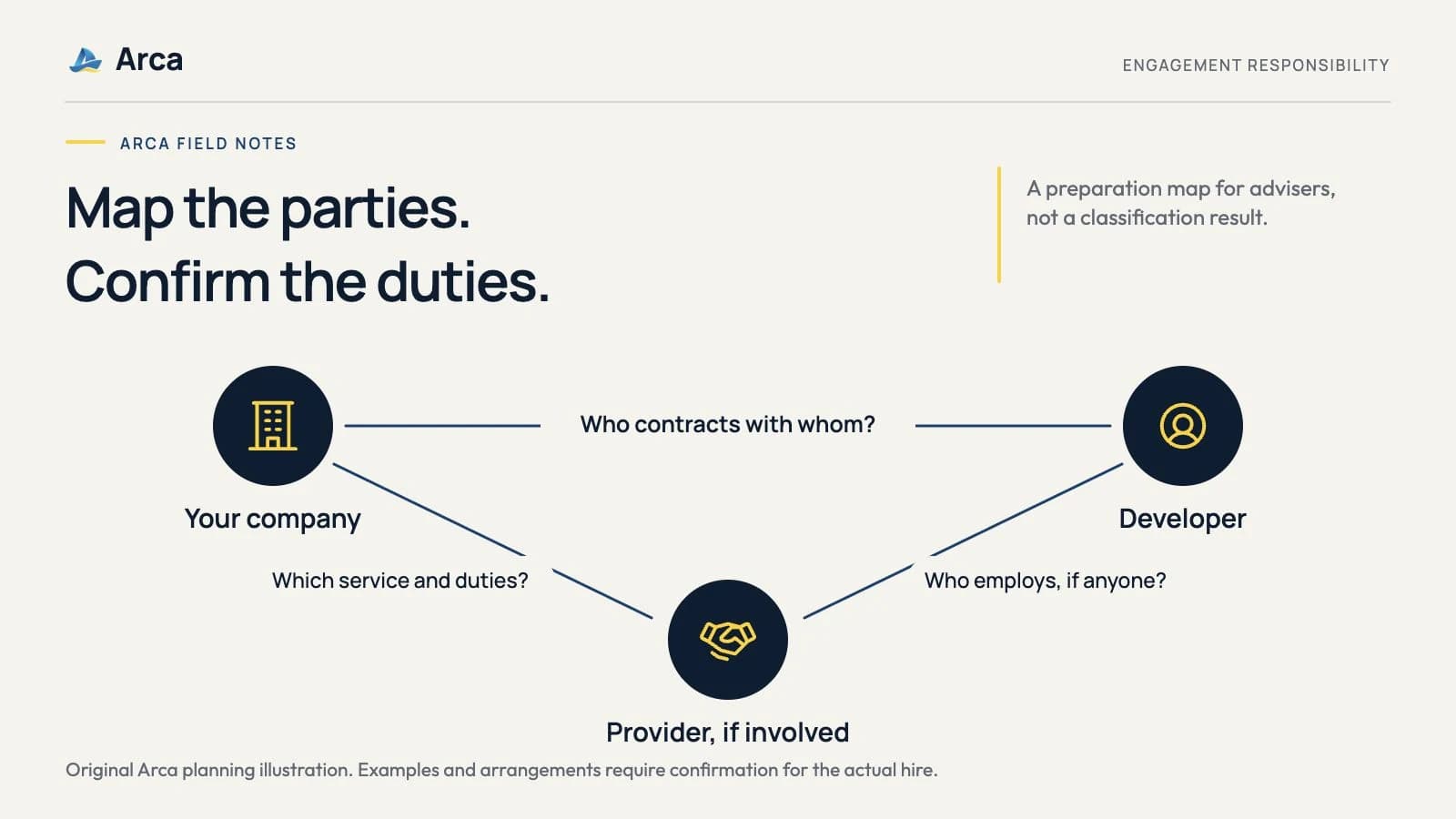
Before hiring a Philippine developer, establish who will contract with the engineer, who will employ them if the arrangement is employment, and who will carry the relevant administration and compliance responsibilities. “Employee,” “contractor” and “provider-supported” describe different parts of the arrangement; a provider's marketing label cannot settle all three.
Start with the actual working relationship and have qualified advisers review the applicable employment, tax and business requirements. This article is a preparation worksheet for that discussion, not a classification opinion or instructions for avoiding employer obligations.
Draw the parties before comparing models
Write the legal names of the company buying the service, the party contracting with the developer and any intermediary. Record where the work will occur and what each agreement covers.
For a direct employment proposal, identify the employing entity and its obligations. For a direct contractor proposal, explain the intended independent business relationship and how the work will operate. For a provider-supported proposal, ask whether the provider is recruiting, employing, administering payments or delivering a service—and which party retains each responsibility.
These functions can be combined, but they should not be assumed. A recruiter introducing a candidate and a provider employing an engineer perform different functions. Our staff augmentation versus project outsourcing guide covers direction of engineering work; legal and administrative responsibility needs its own confirmation.
Use facts rather than the invoice label
Prepare the operating facts your advisers need. Who assigns work and controls how it is performed? What hours, tools, exclusivity, supervision, payment and ongoing obligations are proposed? Who can end or change the relationship?
The ILO's Employment Relationship Recommendation No. 198 emphasizes work and remuneration facts over contrary labels. It is a recommendation to member states, not a self-executing classification test for your hire.
The Philippine Supreme Court's Sonza v. ABS-CBN decision examines factors including control in a particular broadcasting relationship. That case illustrates the importance of facts; its result should not be transplanted into a software-engineering engagement without legal analysis.
The IRS's independent-contractor versus employee guidance addresses US federal employment tax and considers control, independence and the parties' relationship. It does not determine Philippine employment status or every US state and federal obligation. Ask your advisers which rules actually apply to your company and proposed arrangement.
Fill the responsibility worksheet
Use this original worksheet to gather answers before signing. A complete table is evidence of preparation, not proof that the legal structure is valid.
| Question | Evidence to request | Owner who must answer |
|---|---|---|
| Who signs with whom? | Draft agreements and the exact contracting entities | Commercial owner and advisers |
| Who is the employer, if this is employment? | Written identification of the employer and its obligations | Proposed employer and advisers |
| How will work operate? | Accurate description of supervision, hours, equipment, discretion and continuity | Hiring manager and developer/provider |
| Who handles pay and required administration? | Responsibility schedule for payroll or invoices, taxes and applicable contributions | Finance, employer/provider and advisers |
| Which worker terms apply? | Applicable leave, benefits, working-time and termination arrangements | Employer and qualified advisers |
| Who controls data and intellectual property? | Relevant agreements, access boundaries and transfer terms | Legal and technical owners |
| What happens when the arrangement changes? | Process for revisiting facts, agreements and responsibilities | Named commercial and compliance owners |
Do not accept “the provider handles compliance” as the final answer. Ask which obligations it handles, for which entity, what documentation supports that role and which responsibilities remain with your company.
For example, the Philippine SSS's employer guidance lists employer duties around registration, reporting, contributions and records. Use that as a prompt to establish responsibility where those duties apply. It does not prove that a particular provider has fulfilled them, and this article does not calculate contributions or assign them to your company.
Walk through a fictional proposal
Imagine a fictional US analytics business that wants continuing help maintaining its application. One proposal offers recruitment only. Another proposes an engineer supported by an identified employing entity. A third offers a direct independent-contractor engagement.
The team should not choose by the simplicity of the monthly invoice alone. For each proposal, it gathers the same operating facts and has advisers assess the structure. It asks the recruitment-only provider what happens after introduction, and the employing provider which party signs the employment agreement and performs the required administration.
The technical lead separately confirms who directs and reviews the engineering work. Product direction and legal employment responsibility may involve different people. Record both so the engineer does not receive contradictory instructions after joining.
Revisit the arrangement when the work changes
A short bounded assignment may develop into continuing work with a different pattern of supervision and availability. Treat material changes as a reason to revisit the legal and commercial analysis, rather than relying indefinitely on the original label.
Keep an accurate record of the arrangement and communicate agreed changes to the developer and relevant parties. Avoid asking someone to sign a description that does not match the way your team intends to work.
Bring the open questions to Arca
Arca helps companies hire software engineers in the Philippines. Discuss the role, intended working relationship and support requirements, then confirm the actual service scope and contracting responsibilities in the proposal. Do not infer an employer-of-record or legal-advisory service from this educational article.
Use our partner-verification guide to organize the evidence you request. Your commercial discussion and qualified legal/tax review should resolve the material responsibilities before work begins.
Frequently asked questions
Does using a provider establish who employs the developer?
Not by itself. Identify the exact entities and whether the provider recruits, employs, administers payments or delivers a service under the actual agreements.
Can a contractor label settle classification?
The actual work relationship and applicable rules need review. A label should not replace analysis by qualified employment and tax advisers.
Do IRS rules determine Philippine employment status?
No. The cited IRS guidance concerns US federal employment tax. Philippine employment law and other relevant obligations need their own analysis.
What should we ask about payroll and contributions?
Ask which entity carries each applicable obligation, what the provider performs and what evidence supports it. Do not assume the invoice includes every responsibility.
When should we revisit the arrangement?
Revisit material changes to work, supervision, availability, parties or location. Do not rely indefinitely on a description that no longer matches practice.