By Jake Parks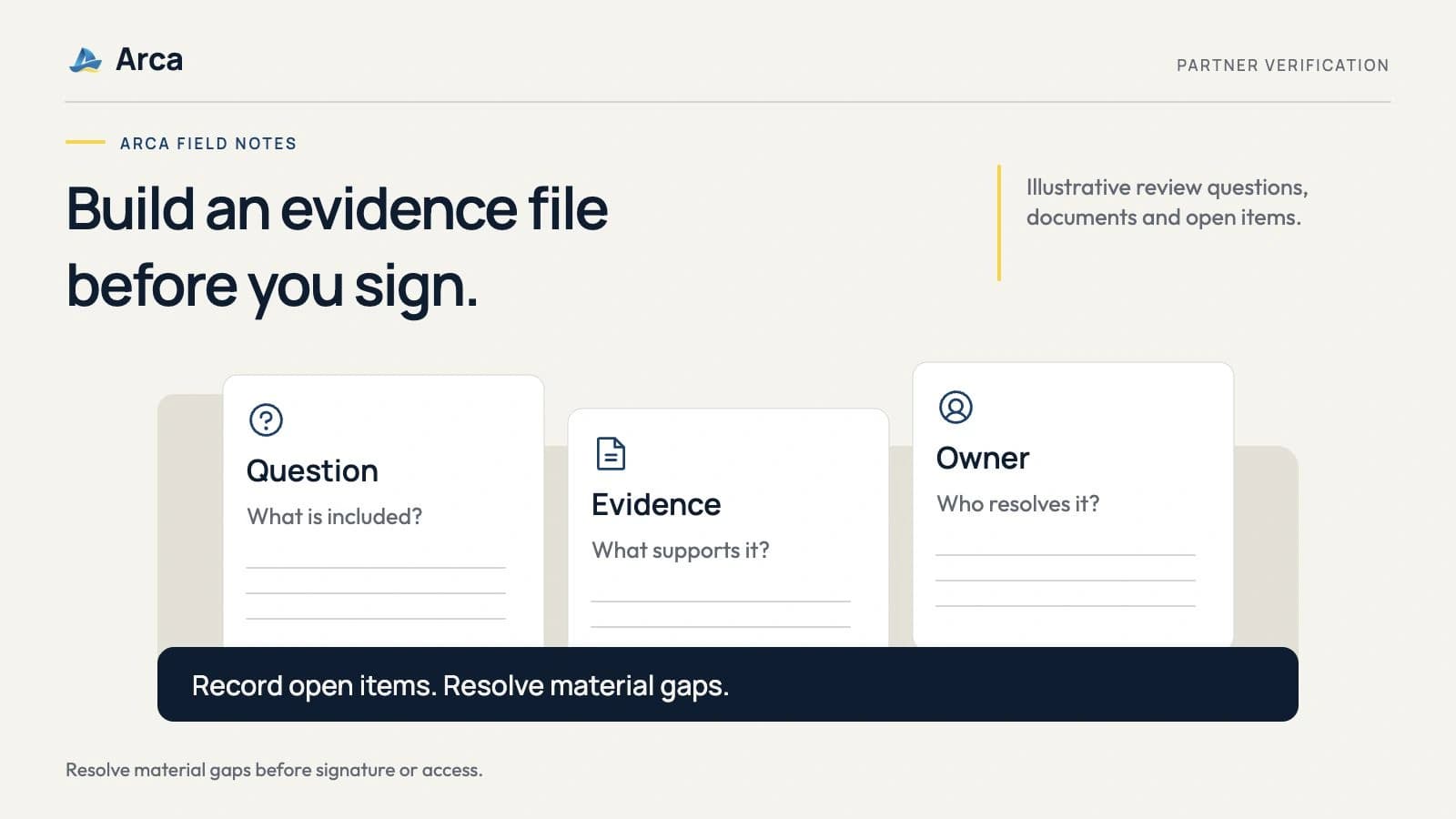
Verify an offshore engineering partner by turning each important promise into a question, a requested piece of evidence and a named decision owner. Check the proposed service, screening method, access arrangements, relevant references and commercial boundaries before you commit. A review score can help you investigate; it cannot answer all of those questions.
This is a practical due-diligence worksheet for a US team considering Philippine engineering talent. It is intended to organize a buying decision, not certify a provider or replace contract and security review.
First establish what the provider is proposing
Ask the provider to finish this sentence: “We are responsible for ___; your company remains responsible for ___.”
There is a material difference between introducing a candidate, supplying an engineer who joins your team and accepting responsibility for a separately managed project. The same word, “outsourcing,” can appear in proposals for all three.
Record who will set priorities, supervise technical work, approve releases, arrange the engagement and respond when something goes wrong. Ask how knowledge and access are transferred during absence or a change of engineer. If the offer includes a partner or subcontractor, identify that party and its role too. Comparing proposals before resolving this can make an inexpensive introduction look equivalent to a continuing service.
Our staff augmentation and project outsourcing comparison can help define the service you actually need. Then investigate the provider against that service.
Build an evidence worksheet before the sales call
Use the questions below as a starting point. The suggested owners are roles within your buying team, not extra positions you must hire.
| Decision to verify | Ask for | Suggested reviewer | Record the result as |
|---|---|---|---|
| Who are we contracting with? | Proposed contracting entity, operating contacts and any subcontractor roles | Commercial owner | Confirmed identity or unresolved question |
| What is included? | Written scope, price inclusions, exclusions and responsibilities | Finance and hiring owner | Comparable scope or material gap |
| How is this role screened? | Explanation of the assessment and a permissible example of the evidence shared with clients | Technical lead | Relevant method or unsupported assurance |
| Who will do the work? | Candidate conversation, relevant experience and confirmed availability | Hiring manager | Fit established or further assessment needed |
| How is access controlled? | Proposed device, identity, repository and offboarding arrangements | IT or security owner | Acceptable controls or actions before access |
| What happens during difficulty? | Escalation contacts, response process and relevant reference discussion | Engineering lead | Usable operating process or dependency |
| How can the arrangement change or end? | Written notice, transition, fees and ownership terms | Authorized commercial or legal reviewer | Accepted terms or negotiation required |
Also allow not applicable, with a reason when the proposed service does not require a particular document or control. A missing document and an irrelevant document are different situations. Do not award a provider a numerical score that obscures a critical unanswered question.
NIST's supplier due-diligence quick-start guide treats due diligence as investigating pertinent supplier information to support an informed decision. Its scope is ICT supply-chain risk. For an engineering staffing engagement, that supports a proportionate supplier investigation; it does not mean every small hire needs an enterprise procurement exercise.
Ask to see how a screening claim becomes evidence
“Vetted” is the beginning of a question. Ask what was assessed, by whom, for which level of responsibility and when. A general programming result may be useful, but it does not establish experience maintaining your particular kind of system. Use the same role-related evidence bar across locations; national rankings are not candidate assessments.
For a backend role, ask how the provider assesses debugging, data handling, testing and explanation of tradeoffs. For DevOps, the relevant discussion might concern release safety, infrastructure changes and incident judgment. Have the eventual technical reviewer help choose the evidence you need.
Respect confidentiality on both sides. A provider should not need to expose a former client's private repository to prove an engineer has done good work. A redacted sample, structured discussion or a proportionate exercise can be more appropriate. Arca's engineering interview guide offers one way to connect assessment evidence to a real role.
Investigate reviews and references without treating them as guarantees
Read what the reviewer actually purchased. A positive account of administrative support is not evidence about engineering screening. A completed website project does not establish how a provider supports an engineer embedded in someone else's product team.
Look for the relationship, dates, work involved, difficulty encountered and how the provider responded. If several sites repeat one client's story, treat that as one underlying engagement rather than several independent outcomes.
The FTC's guidance on evaluating online reviews recommends considering the source and warns that appearance alone cannot reliably distinguish genuine and fake reviews. A mixed rating is not automatically proof of honesty, and a high rating is not automatically proof of manipulation.
When a provider can arrange an authorized reference conversation, ask specific questions:
- What did your team still need to manage?
- Did the person introduced match the role you discussed?
- How were problems raised and followed through?
- What would you clarify earlier if starting again?
A reference may be unavailable for legitimate confidentiality reasons. Record the limitation and consider what other evidence could address it; do not treat hesitation by itself as proof of wrongdoing.
Check the working controls behind security language
A claim about being “secure” needs context. Ask who approves access, which systems the engineer needs and how that access ends. Establish the process for reporting a suspected incident before sharing sensitive information.
If a provider presents a certification, request the relevant certificate and inspect its subject, scope, issuer and status. ISO's certification guidance explains that external certification bodies issue certificates and provides verification routes. A badge should lead to a checkable claim; it does not demonstrate that every activity in your proposed engagement is covered.
Also distinguish a supplier's organizational controls from your team's development practices. NIST's Secure Software Development Framework provides a shared vocabulary for discussing secure software work with suppliers. You can use it to frame questions about review, release and vulnerability handling. It is not evidence that the provider or your product has implemented those practices.
Turn unresolved answers into a buying decision
Consider a fictional company hiring an engineer to maintain a customer-facing application. The provider explains its assessment well, and the candidate's experience appears relevant. But the proposal says only “ongoing support,” without identifying the contact or whether a technical issue goes to the provider or the client's lead.
The next step is a written clarification, not an automatic rejection or an optimistic assumption. The buyer could agree that its lead owns technical decisions while a named provider contact handles fit and communication concerns. If the buyer instead needs someone to accept project delivery responsibility, the proposed service may be the wrong arrangement.
Record what must be resolved before signature, before system access and after the start. Assign each item an owner and a follow-up date. Use a small paid initial scope only when the parties agree on its purpose, assessment, access and commercial terms; a “trial” label alone does not remove risk.
Apply the same questions to Arca
Arca focuses on software engineering talent in the Philippines, with role-specific assessment and matching to the client team's needs. We introduce a focused shortlist, and your team makes the hiring decision. Engineers join the tools and routines of a team you direct.
Ask us how those steps apply to your role. Bring the responsibility, stack, required working window and questions from your worksheet. Confirm pricing, engagement arrangements and support terms for the specific proposal rather than inferring them from a general description. A useful partner conversation should leave you with fewer assumptions and a clearer decision.
Frequently asked questions
What if a provider cannot share a client reference?
Confidentiality may be a legitimate limit. Record what cannot be checked and ask whether a redacted example, permissible process walkthrough or other relevant evidence can address the same question.
Is a security certification mandatory for every engineering hire?
That depends on your risk, contractual requirements and applicable obligations. Have the relevant security or commercial owner decide what is needed; do not use a logo as a substitute for understanding the proposed access and controls.
Does this worksheet amount to a security audit?
No. It organizes buyer due diligence. A formal technical audit, contract review or regulated assessment may require a qualified reviewer and a different scope.
Should we automatically reject a provider with a negative review?
Read the underlying engagement, dates, issues and response. A rating does not by itself establish whether the proposed service fits your role, and a mixed rating is not proof that every review is genuine.
Does Arca take over project delivery?
Arca's public working model places an engineer in a team you direct. If you need separately managed delivery, describe that requirement and confirm whether the specific proposal includes it.