By Jake Parks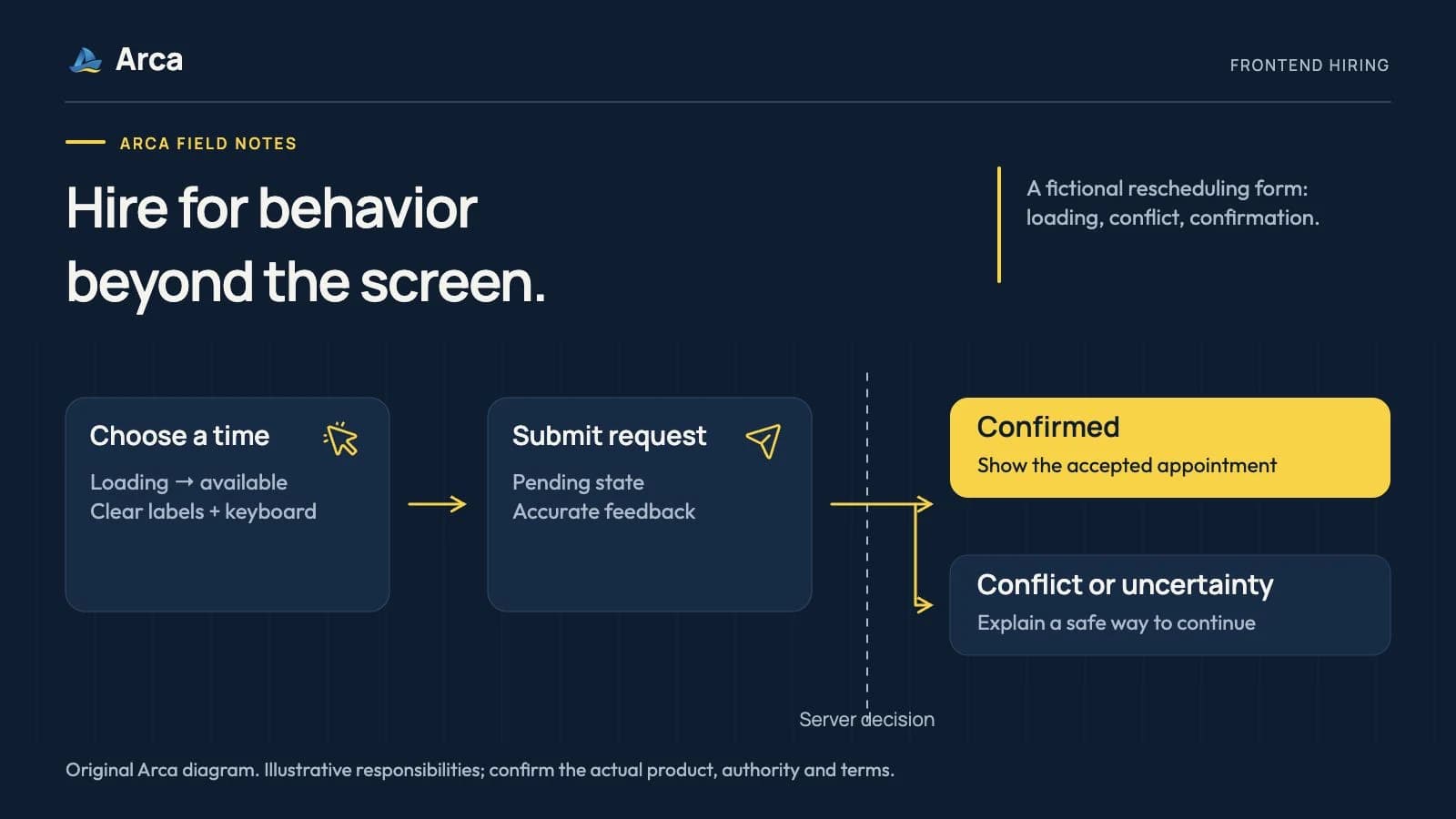
A frontend engineer hiring brief should explain how the product must behave, including loading, errors, accessibility and API interaction. A screenshot can show the intended appearance. It cannot specify everything the engineer needs to make the workflow usable and reliable.
For a US team hiring a Philippine frontend developer, describe one representative user journey and the boundaries between design, interface work and backend responsibility. That gives your recruiter a clearer profile and your technical lead more relevant candidate evidence.
Start with a screen that changes state
Consider a fictional service-appointment rescheduling form. A customer chooses another time, submits the request and receives confirmation. Between those actions, availability may change, the network may fail or the server may reject the request.
The responsibility is broader than reproducing a mockup. The engineer needs to represent the state clearly, preserve useful input and work with the API owner on outcomes the interface cannot determine alone.
React's state-management guidance explains state organization and the problems created by redundant information. Use that subject to discuss how a candidate reasons about interface behavior. Do not make a particular state library a requirement unless the actual role depends on it.
Turn the journey into a small acceptance map
This is an original illustrative brief, not a production specification or a complete accessibility audit. The product and technical owners must settle the actual behavior together.
| User situation | Proposed acceptance question | Responsibility to clarify |
|---|---|---|
| Available times are loading | Can the customer tell the form is still preparing useful options? | Frontend loading behavior and API response contract |
| A required value is missing | Is the issue identified and associated with the relevant input? | Product wording, accessible error handling and validation rules |
| The chosen time becomes unavailable | Is the conflict explained without showing a false confirmation? | Backend authority over availability; frontend recovery path |
| The request is still pending | Can the customer understand that submission has not finished? | Interaction state and handling of repeat actions |
| The request succeeds | Does the interface show the confirmed appointment returned by the service? | Response meaning and confirmation behavior |
| The network outcome is uncertain | Can the customer understand what is known and how to continue safely? | API investigation or status check, with a product-approved recovery path |
Keep an unresolved item visibly unresolved. If nobody knows how to determine whether a timed-out request succeeded, that is a product/API dependency to investigate, not a message the frontend engineer should invent.
Include accessibility in the responsibility
Ask how the form works with keyboard input, meaningful labels, focus and understandable error feedback. The W3C's WCAG 2.2 contains criteria for these concerns. Identify the applicable standard and review process for your product rather than calling one successful keyboard check full conformance.
Describe the environments the engineer must consider: supported browsers, small screens, zoom and assistive-technology testing where relevant. Ask what evidence will accompany a change. A static image from a large monitor cannot show whether a customer can reach and operate every control.
Name who supplies and approves design decisions. If there is no designer, establish who decides wording, interaction and visual consistency. Do not silently add product design, research and complete backend ownership to a frontend vacancy.
Make the client/server boundary explicit
The browser can give useful feedback before submission, but it cannot be the only enforcement point for important rules. MDN's form-validation guide explains why client-side checks must be complemented by server-side validation and security checks.
In the appointment example, the backend must decide whether a requested slot is available and authorized. The frontend must handle the response accurately. Agree the error states, relevant data and who can change the contract before assessment or implementation.
If the role includes API changes, say so and assess that responsibility. Otherwise identify the receiving backend engineer. Our backend hiring guide covers that separate ownership decision.
Ask for evidence beyond a polished screenshot
A bounded assessment can show the synthetic screen and a few response examples, then ask the candidate to explain state transitions, checks and open questions. Avoid requesting a production-ready implementation without an agreed scope and compensation arrangement.
Discuss performance in terms of the actual user journey. Google's Web Vitals documentation describes loading, interactivity and visual stability measures. Those measures can inform performance expectations; they do not prove that a candidate's past work or a proposed redesign will meet a target without measurement.
Ask how the engineer would verify a slow loading state, a rejected submission and successful confirmation. Let them explain a suitably simple approach. An extensive tool list is less useful than reasoning about the behavior your users need.
Give the recruiter a usable frontend profile
Summarize the product responsibility, required stack knowledge, design support, API collaborators and evidence your lead will assess. Separate capabilities needed immediately from tools the team can teach.
Bring that brief to Arca when discussing a Philippine frontend engineering hire. Use the shared hiring-brief template for the overall role and the developer evaluation guide to organize consistent assessment. The screen becomes useful hiring context once its behavior and responsibility boundaries are visible.
Frequently asked questions
Is a mockup enough to define frontend work?
No. Add behavior for loading, validation, server responses, errors and recovery, along with ownership of unresolved decisions.
Does frontend validation replace server checks?
No. Client-side feedback helps users, while server-side validation and security checks remain necessary at the system boundary.
Should the vacancy require a particular state library?
Require it only when the actual assignment needs it on entry. Assess reasoning about data flow and interface states separately from library familiarity.
Does one keyboard check establish WCAG conformance?
No. Identify the applicable standard and review scope. A single interaction check cannot establish full conformance.
Who should decide API error behavior?
The product and technical owners should agree the response meaning and recovery path with frontend and backend engineers. Record unresolved behavior before assuming implementation can proceed.