By Jake Parks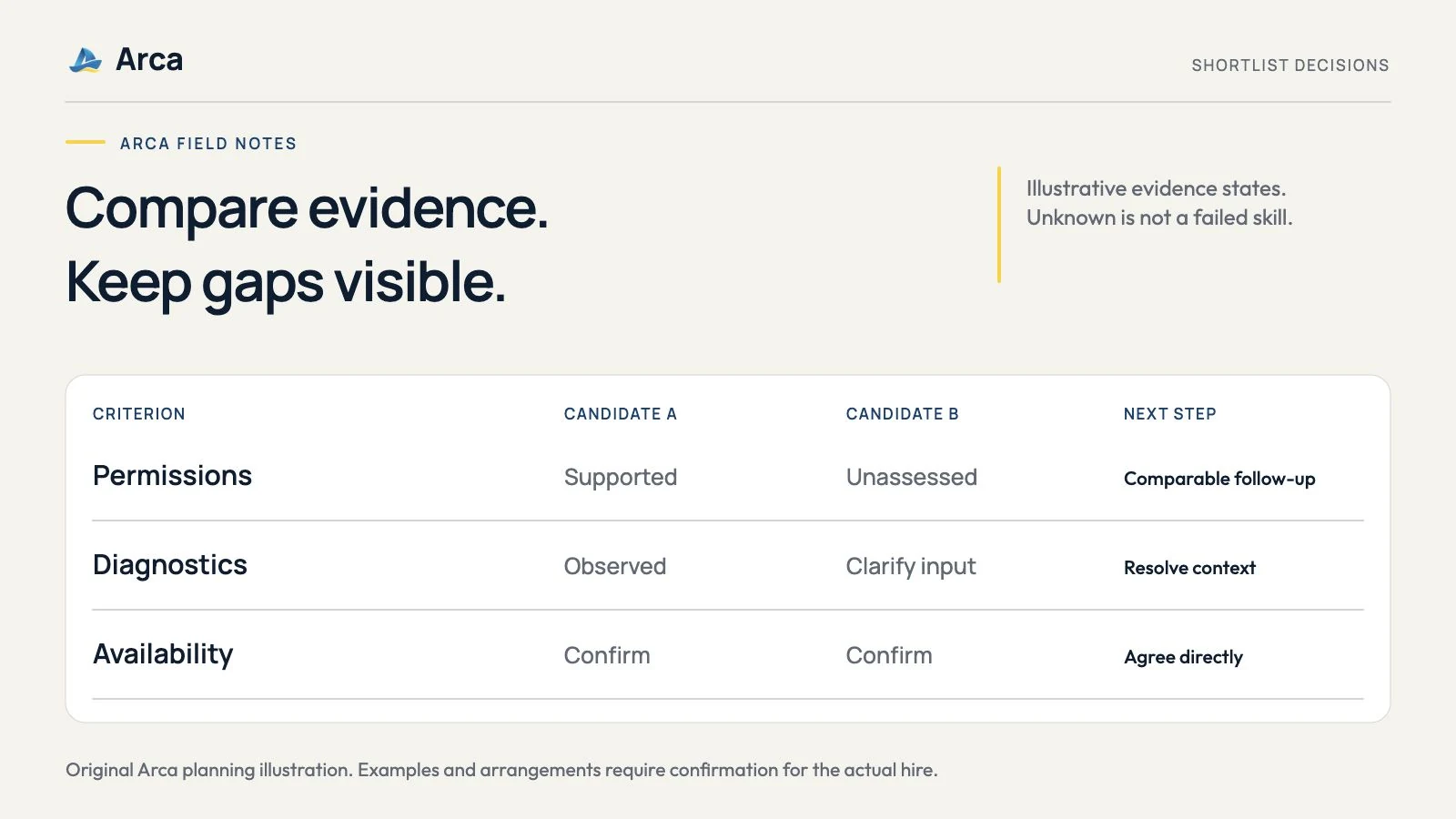
Compare offshore developer candidates against the same job responsibility and evidence requirements. Keep demonstrated capability, unresolved questions, team support and commercial fit visible in one place. A total score should not hide a missing capability that matters to the work.
A shortlist is a starting point for this decision. For a US team hiring a Philippine software engineer, the useful question is which candidate can perform the agreed assignment with the support actually available—not which profile sounds most senior.
Agree the criteria before the interviews
Use the hiring brief to select a small number of job-related criteria. State what evidence would support each and which gaps would change the hiring decision. Keep availability, engagement terms and technical capability separate: an earlier start cannot establish engineering fit.
OPM's structured-interview guidance describes consistent questions and rating standards. Prepare the core questions together and have interviewers record observations before the group debrief. That makes disagreement easier to examine without turning the first person's impression into everybody's conclusion.
Avoid criteria such as “feels like us” or “impressive energy.” Replace them with behaviors the role requires: explaining an uncertain result, incorporating review feedback or making a technical recommendation with assumptions visible.
Use evidence states before numbers
This fictional comparison concerns an engineer who will maintain an account-data export. The team has a product manager and a technical reviewer. Candidate A and Candidate B are invented; the entries are examples of interview notes, not findings about real people.
| Criterion | Candidate A: observed evidence | Candidate B: observed evidence | Follow-up or decision |
|---|---|---|---|
| Protect export permissions | Identified an account-boundary check in the synthetic scenario | Discussed output formatting; permission reasoning was not elicited | Ask B the same permission prompt; record this as unknown until assessed |
| Diagnose incomplete output | Traced one failure using the supplied sample logs | Proposed useful checks but needed clarification about the input | Clarify the same input assumptions for both candidates |
| Leave maintainable work | Explained tests and a small change; documentation evidence remains limited | Explained tests and a concise operating note | Assess documentation only to the depth the role needs |
| Work with the technical reviewer | Asked who approves a changed export rule | Suggested implementation choices but did not discuss approval | Probe decision boundaries using the same scenario |
| Fit the working arrangement | Proposed hours need confirmation | Proposed hours appear compatible but are not agreed | Confirm directly; do not infer from location |
Use labels such as supported, unclear and material concern, accompanied by the underlying observation. An unanswered question is not evidence that the candidate cannot do the work. A material concern also needs a specific explanation; it should not become a polite label for an unsupported preference.
Distinguish a missing answer from a missing skill
Before adding another assessment, inspect the notes. Did the interviewer ask the relevant question? Did the candidate receive the necessary context? Was an interruption or inaccessible format involved? If the evidence was never collected, use a focused follow-up rather than assuming the worst.
OPM's work-sample guidance ties exercises to work performed on the job. A small synthetic export example can reveal relevant judgment without asking candidates to build a production feature.
Agree the scope, permitted tools, time, accessibility arrangements and compensation where appropriate. Keep comparable candidates on comparable material. If one receives a helpful clarification, make it available to others who face the same ambiguity.
The EEOC's guidance on employment tests and selection procedures explains US federal discrimination risks in selection. A tidy matrix does not establish legal compliance or remove bias. Use job-related criteria and seek appropriate advice about the actual process and jurisdictions.
Hold a debrief that can change its mind
Ask each interviewer to identify a conclusion, its evidence and its limit. For example: “A described a permission check, but we have not observed an implementation.” That is more precise than “A is excellent at security.”
Use the engineering subjects in Google's code-review guidance—including behavior, design and tests—to check whether the technical discussion covered the role. These subjects help interpret evidence; they do not supply automatic hiring weights.
Where interviewers disagree, compare observations before preferences. A candidate may have shown good reasoning in a domain they know less well. Your team must decide whether the remaining learning fits the support available. Do not rewrite the role around whichever candidate was most persuasive in conversation.
If neither candidate meets an essential responsibility, reconsider the search or the support arrangement. Choosing the higher total in a weak shortlist cannot make an uncovered requirement disappear.
Record the decision and the conditions for success
Write a short rationale covering the assignment, evidence, unresolved items and support commitments. Confirm availability and commercial terms independently. Restrict candidate notes to people who need them and follow your retention and privacy requirements.
Bring the agreed criteria to Arca so the Philippine engineering search follows the same responsibility your lead will assess. Our developer evaluation guide covers the interview itself; this matrix helps the team compare its results. Use the hiring brief if the debrief exposes a disagreement about the role.
Frequently asked questions
Should we use a weighted candidate score?
A score can organize information, but retain the underlying evidence and essential requirements. Do not let a strong total hide a material gap.
How should we record a question nobody asked?
Mark it as unassessed or unclear, rather than a failed capability. Use a focused, comparable follow-up if the answer could change the decision.
What if interviewers disagree?
Compare specific observations, context and limitations before preferences. Check whether they assessed the same responsibility with comparable information.
Can availability compensate for missing technical evidence?
Treat availability and capability separately. An earlier start does not establish that the candidate can perform an essential responsibility.
What if no shortlisted candidate meets the role?
Revisit sourcing, scope or team support. Selecting the highest score cannot resolve an essential requirement that none of the candidates demonstrated.