By Jake Parks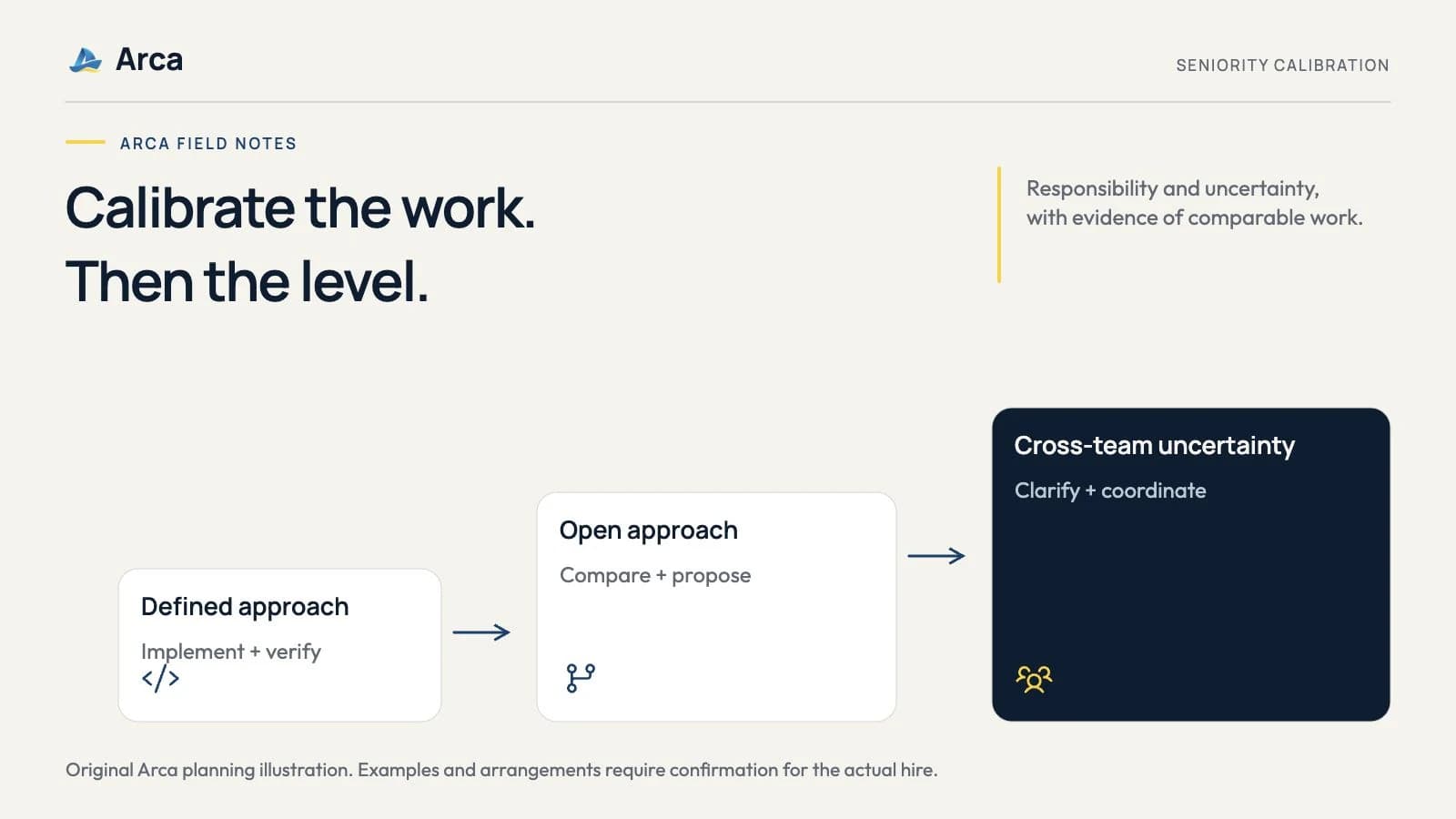
Calibrate software engineer seniority by connecting the responsibility you need with evidence of comparable work. A title or number of years can provide context, but it cannot tell you which decisions a candidate can make, what support they need or whether their experience fits your system.
For a US team hiring an offshore engineer in the Philippines, define the expected scope before reviewing the shortlist. Use the same responsibility standard across locations, while assessing stack familiarity and working arrangements separately.
Write the work at three levels of uncertainty
Consider a fictional subscription service changing how customer entitlements are stored. A product lead knows which plans should include each feature. The team needs to preserve access during the transition.
The following is an original calibration worksheet. It describes possible assignments, not a universal career ladder or an assessment licensed from another provider.
| Assignment condition | Responsibility to assess | Evidence worth investigating |
|---|---|---|
| The approach and boundaries are already defined | Implement a bounded change, verify behavior and raise uncertainty | A concrete change the candidate implemented, how it was reviewed and what they checked |
| The intended behavior is clear but the approach is open | Compare implementation options, identify dependencies and propose a safe sequence | A decision they made, alternatives considered and the review or approval involved |
| The problem crosses teams and important constraints remain unresolved | Help clarify the problem, coordinate technical decisions and expose risks others must resolve | A cross-team example with named contributions, dependencies and changes made after feedback |
A role may combine these conditions. Write which occurs most often and where the engineer has authority. Do not make the most expansive row the default merely because the vacancy says senior.
SFIA's explanation of responsibility levels distinguishes responsibility through attributes including autonomy, influence and complexity. It supports looking beyond tenure; the worksheet above is an Arca planning example, not a conversion into SFIA levels.
Separate level from relevance
An engineer may have independently operated a small application without having changed a subscription system under load. Another may understand a large company's release process but have worked within tightly bounded assignments. Neither history deserves an automatic upgrade or rejection.
Ask what the candidate personally decided, what was already established and who reviewed the result. Then compare the environment: product risk, data sensitivity, system scale, dependencies and available support. A gap in one unfamiliar framework is different from a gap in the responsibility that drives the hire.
Use OPM's job-analysis method to connect the vacancy's tasks and competencies. Keep “can learn our library” separate from “must independently judge this migration” so a long technology list does not obscure the real requirement.
Collect a short evidence record
For the entitlement example, prepare a sanitized description of the old and proposed behavior. Ask every candidate to identify assumptions, affected users and the decisions they would need before recommending a change. You are examining reasoning, not asking someone to solve your live migration for free.
Record the evidence in three columns: observed contribution, relevance to our assignment, uncertainty still open. A candidate who notices that existing users may lose access has identified a relevant risk. You still need to learn whether they can investigate it and work through a suitable change with your team.
For past-work discussions, follow the same core prompts and use agreed evaluation criteria. OPM's structured-interview guidance explains that consistent job-related questions and rating standards create more structure. Additional probes can clarify an answer without changing the responsibility being assessed.
Ask candidates to discuss work they are allowed to share. An architecture sketch with anonymized context can be sufficient; confidential repositories and customer records are unnecessary.
Test whether the explanation survives review
Provide a small synthetic proposal that contains an unresolved edge case. In the entitlement example, a queued job may continue using the old representation while another component reads the new one. Ask the candidate what they would investigate and which colleague should be involved.
Look for a clear explanation of consequences, checks and ownership. Do not reward a particular tool name when several approaches could fit the constraints. Google's code-review checklist supplies useful engineering subjects such as design, behavior, tests and complexity; it is not a hiring score or proof of seniority by itself.
Keep the exercise bounded and agree duration, tools, accessibility needs and compensation as appropriate. Use the same material and expectations for comparable candidates. If you change the requirement materially, recalibrate the process rather than applying a new standard only to the final applicant.
Make a scope decision before negotiating the title
The output should read like a staffing decision: “We need someone who can propose and review the migration approach with our lead; we can teach the internal billing library.” That is more actionable than “strong senior developer with eight years.”
If the evidence supports a narrower assignment, decide whether the team can provide the remaining support. Do not silently give a candidate a wider role after selection. Equally, avoid rejecting a capable specialist because they have not managed people when people management is absent from the job.
Share the responsibility and evidence requirements with Arca when discussing your Philippine engineering search. Use the hiring brief to keep recruiter and technical lead aligned, then use the developer evaluation guide to plan the assessment conversation.
Frequently asked questions
How many years make an engineer senior?
There is no universal conversion in this guide. Examine decisions, responsibility and relevant work, using tenure as context rather than an automatic level.
Is seniority the same as stack familiarity?
No. Assess responsibility and relevance separately from tool knowledge. Decide which stack skills are essential now and what the team can teach.
Must a senior developer manage people?
Only if people management is part of the role. An experienced individual contributor can provide technical judgment without direct reports.
What if evidence supports a narrower role?
Decide whether a narrower assignment and available support meet the product need. Agree that scope explicitly rather than expanding it silently after selection.
Is the worksheet a formal SFIA assessment?
No. It is an original planning example. SFIA is referenced for its distinction between responsibility attributes, not used as a licensed scoring or level-conversion tool.