By Jake Parks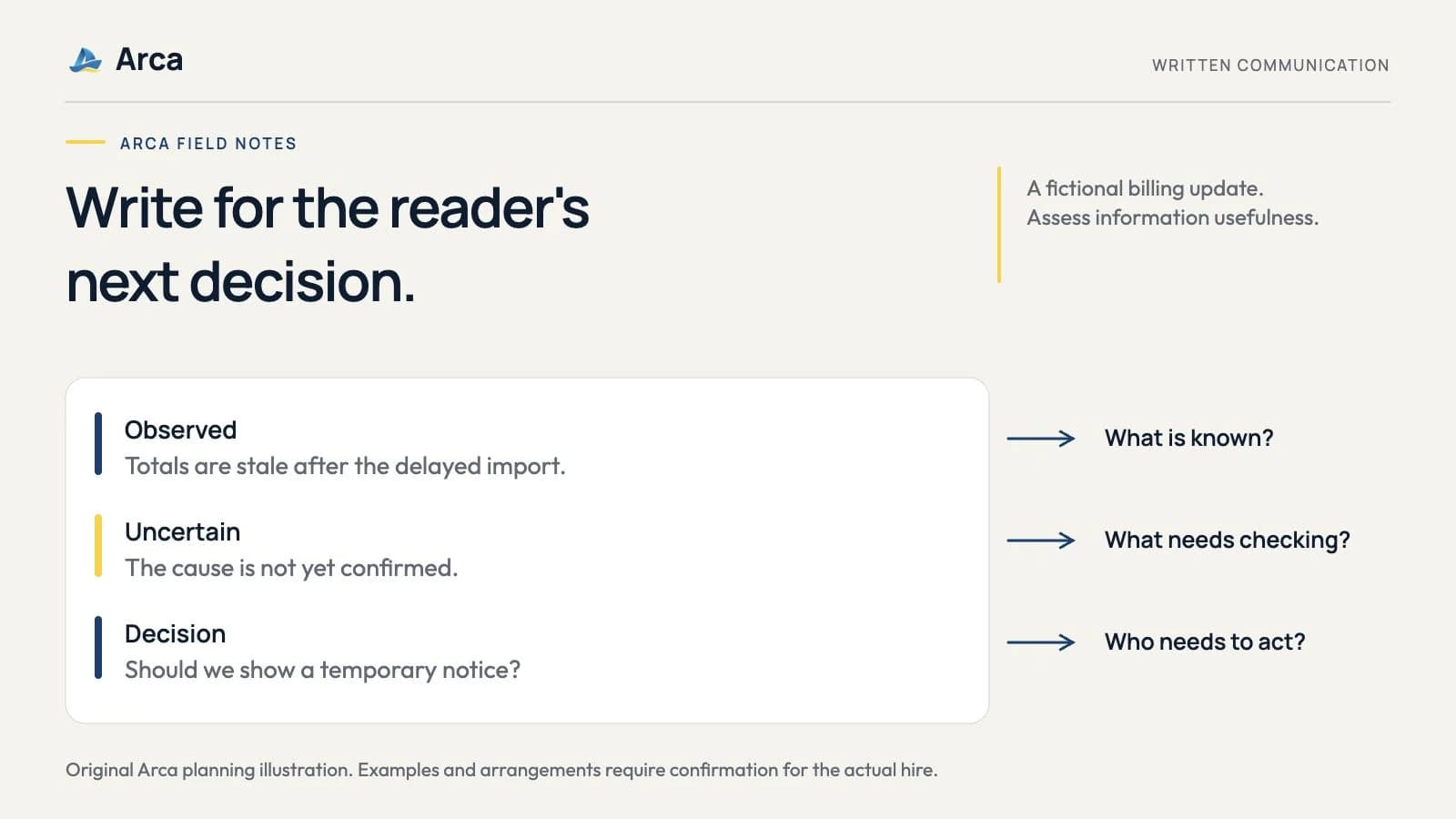
Assess an engineer's written communication through the work your team needs them to do: explain a problem, distinguish facts from assumptions, ask for a decision and leave another person able to continue. Use the same relevant task and criteria across candidates. A writing exercise should not become a test of personality, cultural similarity or polished marketing prose.
For a US–Philippines engineering team, written communication matters when colleagues work at different times. Evaluate that practical responsibility directly rather than inferring it from an accent, interview confidence or how familiar someone's conversational style feels.
Choose the reader and the decision
A technical investigation note and a product update serve different readers. Decide which the role needs before drafting an exercise. A backend engineer may need to explain a failed job to another developer; a technical lead may also need to describe the consequence to a product owner.
Use a small synthetic situation with enough context to respond. For example, a fictional billing dashboard shows stale totals after a scheduled import was delayed. The engineer knows the last successful run, which customers may see stale information and that the cause remains unconfirmed.
Ask the candidate for a short update to the product owner and a note for the receiving engineer. This is a proposed exercise, not a validated assessment or a real client incident. Agree duration, tools, compensation where appropriate and accessibility arrangements before starting.
Look for usable information
The worksheet below evaluates the content of the answer. It does not impose a preferred writing voice or assign a personality label.
| Communication need | What the assessor looks for | What it does not establish |
|---|---|---|
| Describe the observed state | Identifies stale totals and the last confirmed successful run | That the candidate has diagnosed the cause |
| Bound uncertainty | Separates known facts from hypotheses and missing information | That every cautious phrase signals weak confidence |
| Explain the consequence | States which workflow or users may be affected using the supplied facts | A dramatic risk estimate unsupported by the scenario |
| Request action | Names the question, proposed owner and useful response window | That forceful wording shows better leadership |
| Enable continuation | Includes relevant context, checks and the next step | That long messages are automatically more complete |
For the product owner, a useful answer might explain that totals are stale, the cause is being investigated and a decision is needed about a temporary notice. For the receiving engineer, the useful material may be the job identifier, synthetic log excerpt and checks still required. Do not demand invented details that the exercise did not provide.
Microsoft's async collaboration checklist emphasizes context and recorded decisions. Those are appropriate subjects for a work-related exercise; they do not prescribe one accent, dialect or style.
Make the process consistent
Prepare the same scenario and core prompts for comparable candidates. Tell them who will read the response and whether documentation, translation, grammar or AI tools are allowed. If verification and disclosure of tool use matter in the job, state that expectation in advance.
OPM's structured-interview guidance supports consistent job-related questions and evaluation standards. You can apply that discipline to the follow-up discussion: ask each candidate why they included particular information and how they would revise it for another reader.
Do not penalize a missing fact when the instructions never supplied it. Equally, do not reward an answer for sounding certain if it invents a cause. Record the specific content that helped or hindered the reader.
The EEOC's selection-procedure guidance explains US federal discrimination considerations, including job-relatedness and disability issues. Use qualified advice for the actual hiring process. An editorial worksheet is not a legal compliance determination or proof that an assessment has no adverse impact.
Include a revision conversation
Give one clear clarification, such as: “The product owner wants to know whether the report can be used for today's decision.” Ask the candidate to revise the update using the information available.
Look at whether the revised message answers that reader's question while keeping uncertainty visible. A concise request for missing evidence may be more responsible than a confident answer the scenario cannot support. Keep this follow-up comparable across candidates.
For technical feedback, Google's code-review comments guide recommends explaining reasoning and commenting on the work rather than the person. That is a useful practice for the assessor too: “The update omitted the affected workflow” is actionable; “not a strong communicator” leaves the evidence unclear.
Spelling and grammar can matter when they prevent understanding or are genuinely essential to a specific responsibility. Describe that requirement in proportion to the job. Do not treat every harmless variation in English as evidence of weak engineering capability.
Carry the result into the working agreement
Record what the exercise demonstrated and what remains untested. A short update does not prove spoken facilitation, customer handling or long-term collaboration. Assess those separately when the role actually needs them.
Bring the communication responsibility to Arca alongside technical requirements and actual collaboration hours. Our hiring brief helps describe the requirement, while the US–Philippines overlap guide helps your team agree when written and live communication will occur.
Frequently asked questions
Should writing style determine the communication result?
Assess whether the intended reader can understand the facts, uncertainty and action. Require a particular style only where it is genuinely relevant to the role.
Can a written exercise assess spoken communication?
It supplies evidence of the written task only. Assess spoken facilitation or customer interaction separately when the job requires it.
Should candidates be allowed grammar or AI tools?
Set a policy reflecting the job and apply it consistently. State permitted data, verification and disclosure requirements before the exercise.
What makes a useful follow-up?
Clarify the reader’s decision and ask for a revision using available facts. Compare how the answer becomes more useful without demanding invented certainty.
Does a consistent exercise eliminate bias?
No. Use job-related criteria, accessible conditions and appropriate review of the actual selection process. A worksheet does not prove legal compliance or absence of adverse impact.