By Jake Parks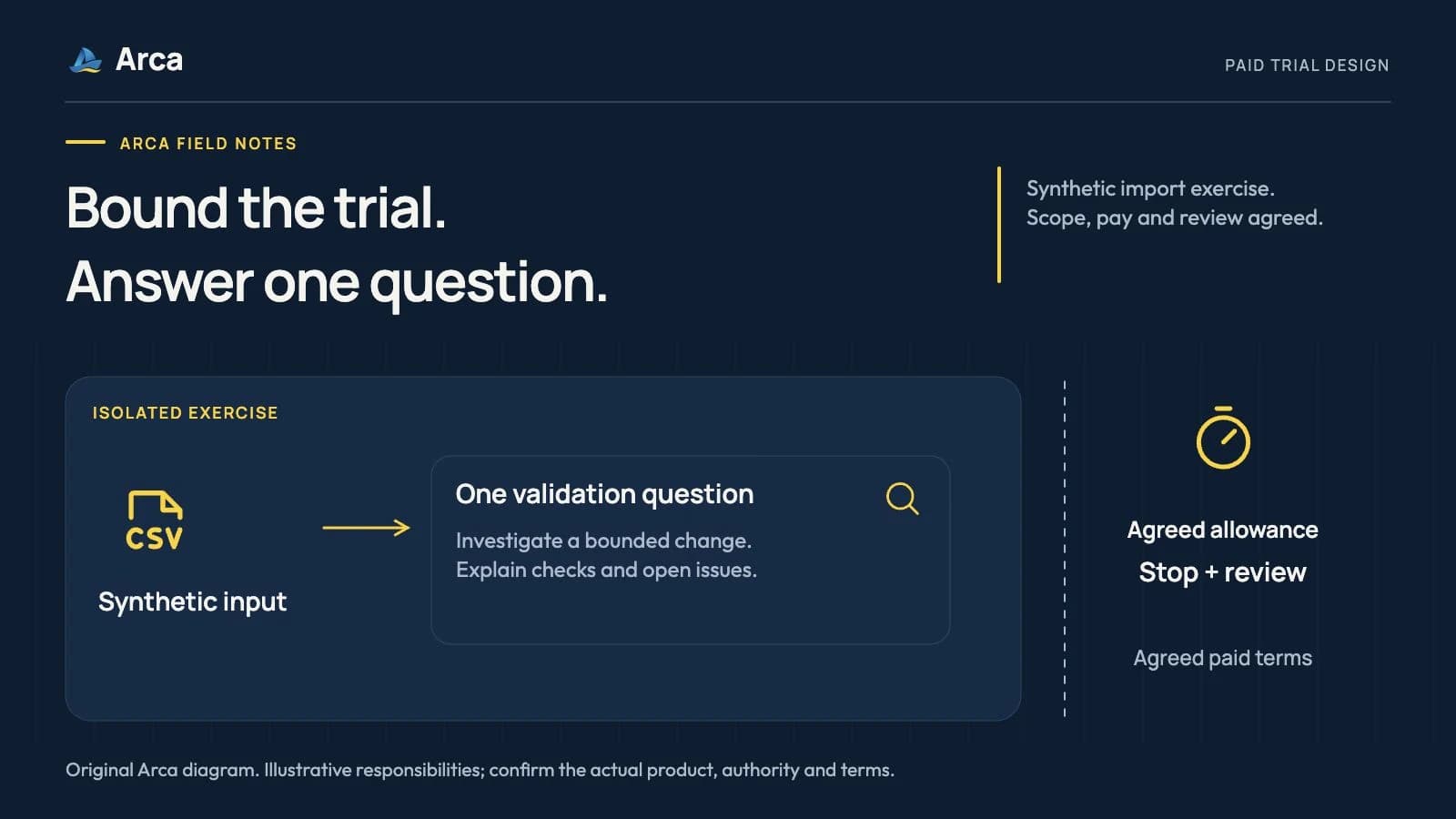
A paid developer trial should answer a specific hiring question that remains after the interviews. Agree the work, compensation, time boundary, permitted tools, access and decision process before the candidate starts. A trial with no clear question is liable to become an open-ended project with an uncertain hiring outcome.
For an offshore engineering hire, the trial can show how a candidate reasons, verifies changes and works with a reviewer. It cannot prove long-term performance, settle worker classification or guarantee that the same commercial arrangement suits every jurisdiction.
Decide whether another exercise is necessary
Review the evidence you already have. If the remaining issue is start availability or an unresolved budget, a coding trial will not answer it. If the role is unclear, fix the brief first. Ask which relevant evidence the recruiter or platform has already collected, and which question remains specific to your assignment. Do not repeat an assessment merely because another provider advertises a trial.
An appropriate question might be: “Can this candidate investigate an unfamiliar input problem, make a bounded change and leave the reviewer able to verify it?” OPM's work-sample guidance connects exercises to actual job tasks. Use that principle to select relevant work, while assessing only the competencies you expect on entry.
Choose the smallest exercise that can reveal the missing evidence. A discussion or short follow-up may be enough. Candidates should know why an additional stage is needed and how the result will be used.
A filled trial brief
The following is a fictional trial design for a team hiring someone to maintain data-import workflows. It is an original example, not a real candidate task, a promised Arca trial programme or a legal agreement template.
| Field | Proposed trial agreement |
|---|---|
| Hiring question | Can the candidate make malformed import rows understandable without silently accepting bad records? |
| Material supplied | A small standalone repository, synthetic CSV files and a description of the intended validation behavior |
| Work boundary | Investigate one validation issue, make a bounded change if feasible and explain remaining questions |
| Time boundary | An agreed paid time allowance and a mutually practical completion window; stop at the allowance |
| Compensation | Written amount or rate, currency, covered time, payment route and due date, agreed before starting and payable under those terms regardless of hiring outcome |
| Tools | Explicit policy for documentation, search, AI assistance and disclosure; no confidential data in unapproved tools |
| Support | Named reviewer and one shared place for clarifications; provide equivalent information to comparable candidates |
| Output | Change or investigation note, checks performed, limitations and a short review discussion |
| Decision | Agreed evidence criteria, decision owner and date for communicating the outcome |
Let the candidate identify an ambiguity. For example, should a blank quantity be rejected or interpreted as zero? The ability to raise that question may matter more than producing a polished interface within the time limit.
If the exercise uncovers a larger issue, stop and discuss it. Do not expand the expected work without a new agreement. A candidate who documents a blocker precisely can provide useful evidence even when the original implementation is unfinished.
Give the trial a safe boundary
Use synthetic records and isolated credentials. The exercise does not need customer data, payment access or production deployment rights. Decide who owns the supplied material and any output, what may be retained and how access will end. Obtain appropriate advice on the actual engagement, compensation obligations, classification and intellectual-property terms.
GitHub's repository-role guidance recommends giving access that fits the person's function. For this example, an isolated exercise repository is a clearer boundary than broad membership in a production organization.
Preparing useful material is part of the employer's work. Check that the repository runs, the instructions match the task and the example files are valid for the exercise. Do not confuse a broken setup with evidence that a candidate cannot perform the role.
Review reasoning alongside the output
Before the trial begins, describe the evidence you will assess. In the import example, that includes identifying invalid input, preserving correct rows, explaining checks and making the limits clear. Avoid quietly adding visual polish or a preferred architecture to the standard after seeing the submission.
Google's code-review guidance covers engineering concerns such as design, functionality, complexity and tests. Select the concerns relevant to this task. The guide is not a proprietary candidate rubric and does not justify demanding every possible improvement in a bounded exercise.
Ask the candidate to explain one choice and one unresolved concern. If AI assistance was permitted, discuss how the output was verified using the same stated policy for everyone. Do not infer that confident presentation establishes authorship or understanding.
Have the reviewer record what they observed and what remains unknown. A successful small trial cannot demonstrate every responsibility in a broader engineering role.
Close the loop with a clear outcome
Communicate the decision when agreed, settle payment under the written terms and close access. If a follow-up engagement is proposed, agree it separately rather than letting the trial continue by default.
Microsoft's async collaboration checklist supports capturing context and decisions in writing. A short trial debrief can record the question, evidence, limits and next step without becoming a personality judgment.
Discuss available assessment options and actual terms with Arca during your Philippine engineering search. Do not assume a public example creates a free-trial, refund or conversion promise. Our developer evaluation guide covers the broader interview process, while the secure-access guide helps define permissions for an authorized engagement.
Frequently asked questions
Does every developer hire need a paid trial?
No. Use another stage only when it can resolve a relevant evidence gap. A focused discussion may answer the question without an implementation exercise.
What should be agreed before the trial starts?
Agree scope, time, compensation, payment terms, tools, access, support, output, rights and the decision process. Obtain advice about the actual engagement and applicable obligations.
Should a trial use live customer data?
The example uses synthetic records and an isolated repository. Production data or permissions are unnecessary for its hiring question.
What if the task exceeds the paid allowance?
Stop at the agreed boundary and discuss the unresolved issue. Do not expand expected work without a new agreement.
Does this describe an Arca trial guarantee?
No. Confirm available assessment options and actual engagement terms directly with Arca. This example creates no refund, conversion or free-trial promise.