By Jake Parks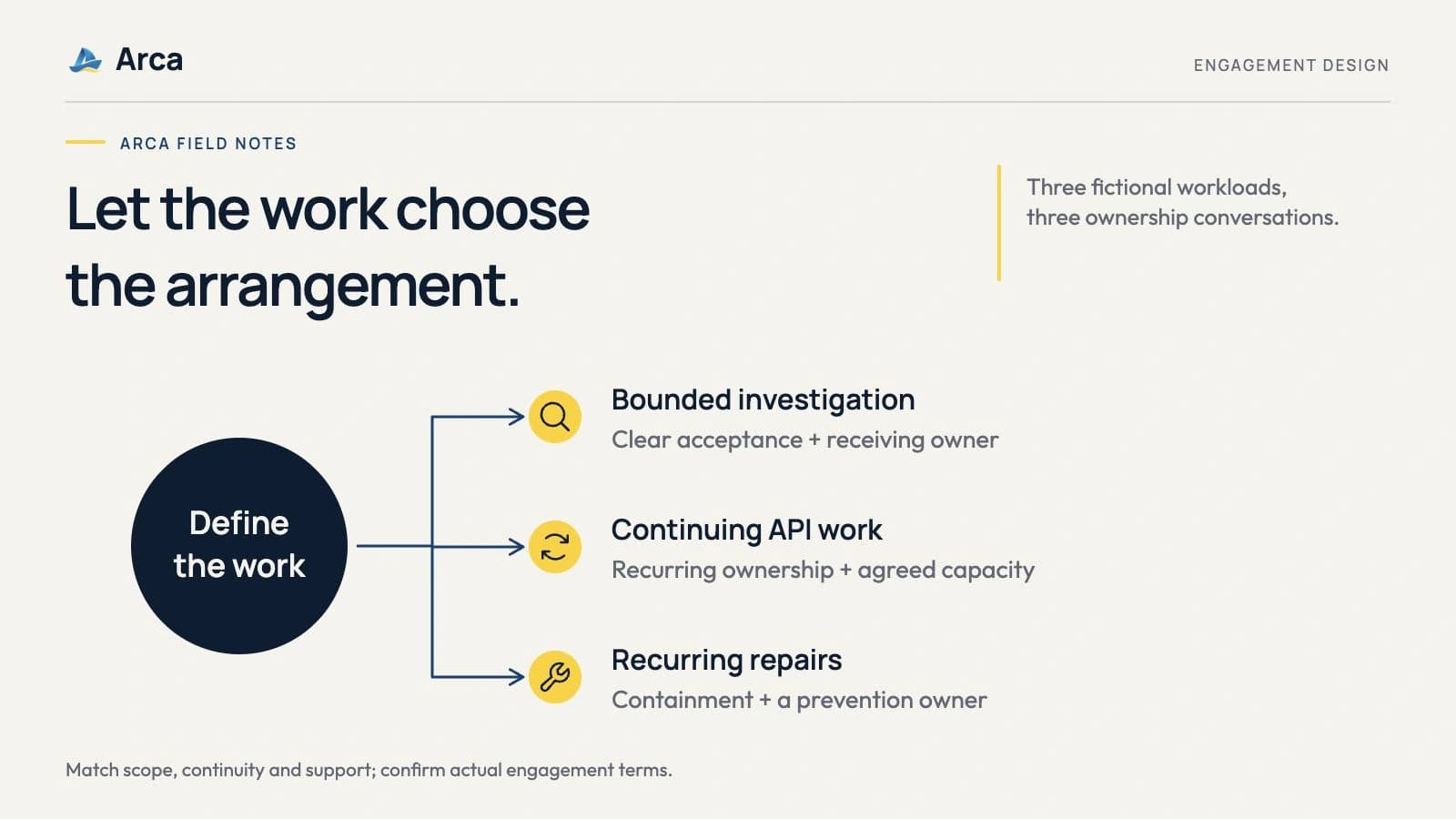
Choose between a dedicated offshore engineer and a freelance developer by looking at the responsibility that remains after the first deliverable. A bounded specialist engagement can fit work with a clear acceptance point and a capable receiving team. Continuing engineering capacity can fit a product area that needs regular changes, accumulated context and agreed availability.
Neither label establishes skill, reliability or legal status. A freelancer can maintain a long relationship, and a dedicated engineer still needs direction, review and a realistic scope. For a US company hiring in the Philippines, the useful question is what arrangement will cover the work you actually need done.
Three engineering situations with different answers
The following scenarios are fictional decision exercises, not Arca case studies.
A specialist reviews a slow reporting query
A product team has traced a performance problem to a reporting workload. Its backend lead can describe the database, provide safe test data and evaluate the proposed change. The team wants an independent specialist to investigate, explain alternatives and help validate a fix.
A bounded freelance engagement may fit. Define access, the investigation boundary, evidence to deliver and what counts as acceptance. Specify whether implementation is included or separately approved. Keep a person inside the team responsible for the system afterward.
The specialist's value comes from experience with the problem. Requiring permanent availability would buy something the team has not established it needs.
An engineer owns continuing API work within a product team
Another team has recurring API changes, defects and integration questions. Each new task depends on decisions made earlier. A technical lead sets architecture and priorities, but the existing engineers cannot cover the backlog sustainably.
A dedicated engineer may fit this continuing responsibility. Agree on availability, review arrangements and the first product area they will learn. The objective is an engineer who can build useful context and contribute to successive decisions, not merely someone whose calendar is full.
“Dedicated” needs a written meaning. Does it describe agreed hours, a named assignment or exclusivity? Record the actual collaboration window separately; being offshore does not establish a US schedule. Do not assume it implies round-the-clock response, unlimited scope or permanent retention.
A one-time cleanup reveals a recurring problem
A third team keeps paying for manual data repairs. It initially asks for a script to clear the current queue. During scoping, it becomes clear that the same integration failure creates new repairs every week.
This may need two pieces of work: a bounded intervention and an internal owner for a lasting fix. Google's SRE discussion of toil distinguishes repetitive operational work from engineering that creates enduring improvement. Applied here, the hiring question is whether you need temporary execution, an engineer to remove the cause or both. It is not a reason to hire a permanent person simply to repeat the repair indefinitely.
Compare the arrangements before comparing people
Use the same actual workload on both sides. The entries below are questions to settle, not guaranteed features of either arrangement.
| Dimension | For a bounded freelance engagement | For continuing dedicated capacity |
|---|---|---|
| Work definition | What deliverable or investigation can be accepted? | What product responsibility will recur? |
| Availability | Which sessions and response windows are agreed? | What working window and capacity are committed? |
| Context | What must be provided upfront? | How will product and system knowledge accumulate? |
| Technical decisions | Who approves the approach and accepts the result? | Who leads, reviews and resolves ongoing tradeoffs? |
| Change | What requires a new estimate or scope agreement? | How are priorities changed within the agreed role? |
| Continuity | Who owns the system after handover? | How is knowledge shared if the person is absent or leaves? |
| Cost comparison | What is included in completion and transition? | What is included across the same planning period? |
If a freelance proposal includes ongoing maintenance, evaluate that actual commitment. If a dedicated proposal excludes incident coverage, record the exclusion. Avoid choosing from stereotypes about which kind of engineer “cares more.”
Define handover before the first change
A short engagement needs an explicit receiving owner. A continuing hire needs one too, because no staffing arrangement eliminates absence or eventual transition.
Write down where code, decisions, deployment instructions and known limitations will live. Keep company-controlled systems under the company's authorized accounts, with appropriate individual access. GitHub's repository documentation explains that repositories can belong to individuals or organizations and that permissions control access. Choose that ownership intentionally rather than discovering at handover that the only usable copy belongs to a departing contributor.
Technical account ownership is different from intellectual-property rights. Have the relevant agreements reviewed; a repository setting alone does not settle those rights.
NIST's Secure Software Development Framework is also useful for agreeing on secure-development expectations with suppliers. For this decision, use a practical subset of questions: how are changes reviewed, how are releases approved and who follows up on a discovered vulnerability? Apply the answers to both short and continuing engagements.
Keep the working arrangement separate from worker classification
“Freelance,” “remote” and “dedicated” describe aspects of how people work. They do not, by themselves, determine the applicable legal relationship.
For US federal employment-tax classification, the IRS examines the actual relationship, including control and independence. That guidance does not decide Philippine employment obligations or every cross-border situation. Get appropriate advice on the proposed arrangement rather than assuming a short project or an invoice settles classification, taxes or other responsibilities.
Resolve the contracting parties, payment basis, confidentiality, ownership, access and ending arrangements before work begins. An operational decision about continuity should lead to a properly reviewed agreement, not substitute for one.
Make a small decision record
Before selecting either route, complete these sentences:
- The work we need done is ___, and we will know it is accepted when ___.
- After the initial work, the recurring responsibility will be ___, owned by ___.
- The required availability is ___; additional coverage will be ___.
- Our technical reviewer is ___, with capacity to provide ___.
- The handover will include ___ in systems controlled by ___.
- We will reconsider the arrangement if ___ changes.
If you cannot name the person who will receive and maintain the result, a short specialist engagement may leave an important gap. If you cannot describe enough continuing work, a dedicated hire may be premature. Changing the arrangement later can be sensible when the workload changes; write down the trigger instead of pretending the first choice must last forever. Revisit scope, availability and the relevant agreement before a bounded engagement turns into a continuing role.
Considering a Philippine engineer through Arca
Arca helps companies source and assess engineering talent in the Philippines for their actual responsibilities, stack and working needs. Engineers join a client-directed team; your team makes the hiring decision and owns technical priorities. Describe whether you need continuing product capacity or a bounded specialist outcome so we can discuss fit without treating those needs as interchangeable.
Confirm the proposed availability, service scope and commercial terms for the individual engagement. For the broader distinction between adding capacity to your team and buying separately managed delivery, see our staff augmentation versus project outsourcing guide.
Frequently asked questions
Can a freelancer work with a company for a long time?
Yes. Evaluate the actual agreement, availability and continuity commitments. Do not assume that a freelance relationship must end after a short project.
Does dedicated mean available twenty-four hours a day?
No. Define the named assignment, capacity, working window and any separate incident coverage. A dedicated label does not establish unlimited availability.
Can we combine a dedicated engineer with specialist freelance help?
Yes, when each has a clear scope and a shared technical owner. For example, a continuing product engineer may work alongside a specialist performing a bounded review, with the team deciding how recommendations are accepted.
Who owns the code in either arrangement?
Confirm the relevant agreements with the appropriate reviewer. Keeping repositories in authorized company-controlled accounts helps operational continuity, but repository settings do not determine intellectual-property rights.
What happens when the work outgrows the initial freelance scope?
Revisit responsibilities, availability, pricing, handover and the relevant agreement before extending it. A change in workload may justify a different arrangement; it should not become an unspoken expectation.