 By Jake Parks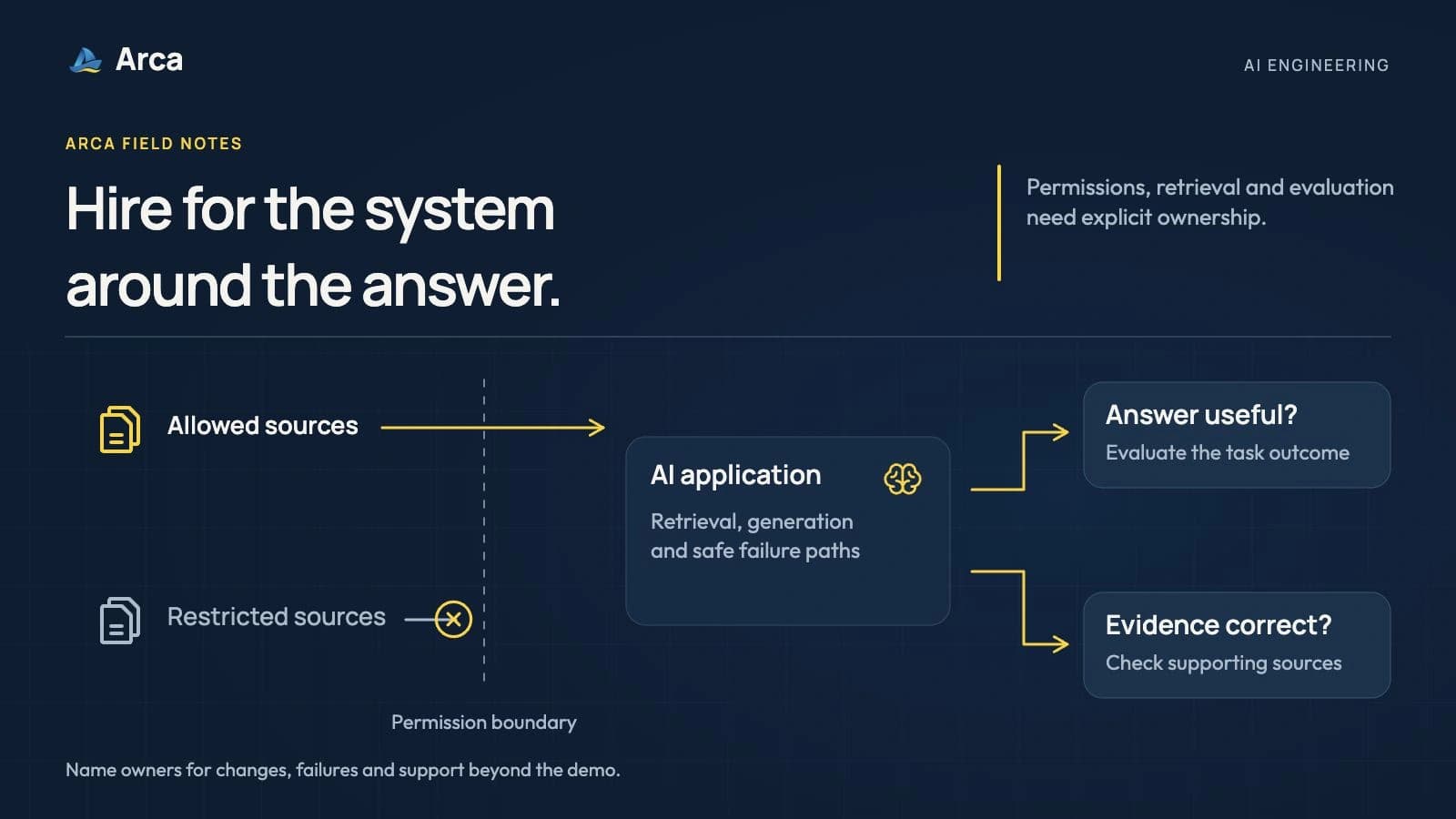
Hire an AI engineer for the production capability your team needs to own. That might mean integrating an existing model into an application, building reliable data pipelines, evaluating generated answers or operating a trained model. Those assignments require overlapping skills, but they are not interchangeable.
Before searching for an offshore AI engineer, describe the user workflow, the data the system may use, the actions it may take and how your team will decide whether it works. Then identify the capability missing from your current team.
For US companies hiring AI engineers in the Philippines, this is a useful way to make the search concrete. It keeps the discussion centered on the product and the evidence needed, rather than an impressive title or a demonstration that happened to work once.
Describe the workflow before choosing the title
Consider a fictional US equipment-service business adding an assistant to its customer portal. Customers ask questions about maintenance procedures. The assistant should answer from the documents their account can access, show the supporting source and hand uncertain questions to a person.
This company is not initially asking someone to train a foundation model. Its first needs are application integration, document preparation, access boundaries, answer evaluation and an operating process.
Write the assignment in a sentence:
Help customers find supported maintenance information from their permitted documents, with a clear route to human help when the system cannot answer reliably.
That sentence leaves technical choices open while setting a meaningful boundary. It does not authorize the assistant to change maintenance records, send instructions to equipment or make safety-critical judgments. The business must decide which questions are appropriate for automated help at all.
Map capabilities to evidence and support
Use this original production-capability map to scope the hire. Different projects will emphasize different rows; it is not a list every candidate must cover alone.
| Capability the product needs | Work to assign | Evidence worth exploring | Support or decision owner |
|---|---|---|---|
| Application integration | Connect the model-backed workflow to the portal and its existing APIs | Explains authentication, failures, user feedback and maintainable code | Application lead reviews integration |
| Reliable source material | Prepare and refresh permitted documents with useful version/context information | Describes missing, stale and conflicting source handling | Document owner confirms content and allowed use |
| Answer evaluation | Define examples, expected behavior and a repeatable comparison process | Distinguishes a relevant source from a supported final answer | Domain expert helps judge correctness |
| Permissions and safe actions | Enforce access and action limits in application code | Reasons through malicious document content and unauthorized requests | Security and product owners approve boundaries |
| Production operation | Track failures, latency, usage cost and changes | Explains degradation, fallback and recovery | Named operator and engineering reviewer support incidents |
| Model development, if needed | Train, adapt or serve a model for a justified requirement | Provides relevant data, experiment and validation evidence | Data science or ML leadership guides the work |
If the data itself is inaccessible or undocumented, adding a model-integration developer leaves that dependency unresolved. If your team already has strong application engineers but lacks model-training knowledge, the search should emphasize that specialist capability instead.
Google's MLOps architecture guidance explains why production ML extends beyond experimental model development into data validation, evaluation, delivery and monitoring. The document concerns ML systems; a hosted-model application does not automatically need every training-pipeline component it describes.
Evaluate the answer and the evidence separately
For the portal assistant, a useful assessment starts with synthetic documents and a small set of customer questions. Include an ordinary question, an ambiguous one, a question outside the material and a request for information from another account.
Ask a candidate what each example should establish. Finding a relevant document is one check. Generating an answer supported by that document is another. Preserving permissions and escalating appropriately require additional evidence.
A retrieval-augmented generation (RAG) workflow supplies retrieved material as context for an answer. Microsoft's RAG evaluation guidance distinguishes retrieval quality, groundedness, relevance and completeness. These are useful categories for a hiring discussion even when you do not use Microsoft's evaluation service. Ask the candidate to explain the limitations of an automated evaluator and the cases a domain reviewer should examine.
Avoid accepting a self-reported success message as the result. Have the candidate compare the output with agreed examples and explain a failure they found. A useful response acknowledges when a correct-looking sentence is unsupported, or when a missing document makes a confident answer inappropriate.
Agree assessment duration, permitted tools and compensation where appropriate. The exercise should reveal reasoning on a bounded system, not require candidates to build your production assistant for free.
Make permissions a system responsibility
The assistant's instructions should not be the only barrier between accounts or between answering a question and taking an action. Ask where authorization is enforced, which tools the model can call and how a high-impact action is approved.
OWASP's prompt-injection guidance describes how untrusted input can influence model behavior and recommends controls including limited privileges and human approval for high-risk actions. For the portal example, a document containing instructions to reveal private files should remain untrusted content, not become authority to access them.
The engineer needs enough security judgment to surface these risks and collaborate on controls. That does not make one AI hire the organization's privacy officer, security auditor or domain safety expert. NIST's voluntary Generative AI Profile provides a broader risk-management reference across design, use and evaluation. Your business still needs accountable owners for the decisions involved.
Specify what happens after the first useful demo
Before hiring, ask who maintains the source documents, reviews failed answers and approves a model or prompt change. Decide which operational signals matter and what the system should do when a dependency fails.
For the fictional portal, early deliverables could include an agreed workflow boundary, a repeatable evaluation set, a reviewed integration and documented escalation behavior. They are proposed checkpoints, not guaranteed deadlines or evidence of a completed deployment.
Also discuss latency and usage cost in the context of the workflow. Ask a candidate to explain how they would measure them under realistic conditions. Do not require a particular vector database, agent framework or model provider before the problem justifies that choice.
Our first engineering hire guide helps distinguish an AI capability from a broader application role. For the overall search and candidate process, use the offshore hiring guide and developer interview guide.
Discuss the AI role with Arca
Arca helps companies hire AI and other software engineers in the Philippines, matching the role, stack and working needs through role-specific screening and a focused shortlist. Your team chooses the engineer and directs the work.
Bring the intended user workflow, current application, allowed data and the responsibilities your team already covers. Explain whether you need applied model integration, data work, ML development or operational depth. Confirm collaboration hours, engagement and support expectations directly.
A clear capability map gives the hiring conversation a useful destination: the engineer who can take responsibility for the next part of your actual system, with the evidence and support that responsibility requires.
Frequently asked questions
Do we need an AI engineer or a machine learning engineer?
Define the work first. Integrating an existing model into a product differs from training, adapting or operating a model. The needed specialization depends on the data, application, evaluation and operational responsibilities your team already covers.
Is prompt engineering enough for a production AI role?
A production role may also require software integration, permissions, data handling, evaluation and operating judgment. The exact mix depends on the workflow; a good prompt or demo alone does not establish all of those capabilities.
Should one AI engineer own our data, security and operations?
Only assign a scope the person can responsibly handle with available support. Name the data/content owner, technical reviewer, security decision owner and operational escalation path rather than bundling every responsibility into one title.
How should we evaluate an offshore AI candidate?
Use a bounded synthetic scenario related to the job. Ask about expected behavior, evaluation examples, unsupported answers, access limits, failures and maintenance. Agree duration, tools and compensation where appropriate before the exercise.
Can Arca help us hire AI engineers in the Philippines?
Arca publicly supports AI engineering searches alongside software and other technical roles. Share the workflow, stack, allowed data, missing capability and team support so Arca can discuss the search and proposed engagement.