By Jake Parks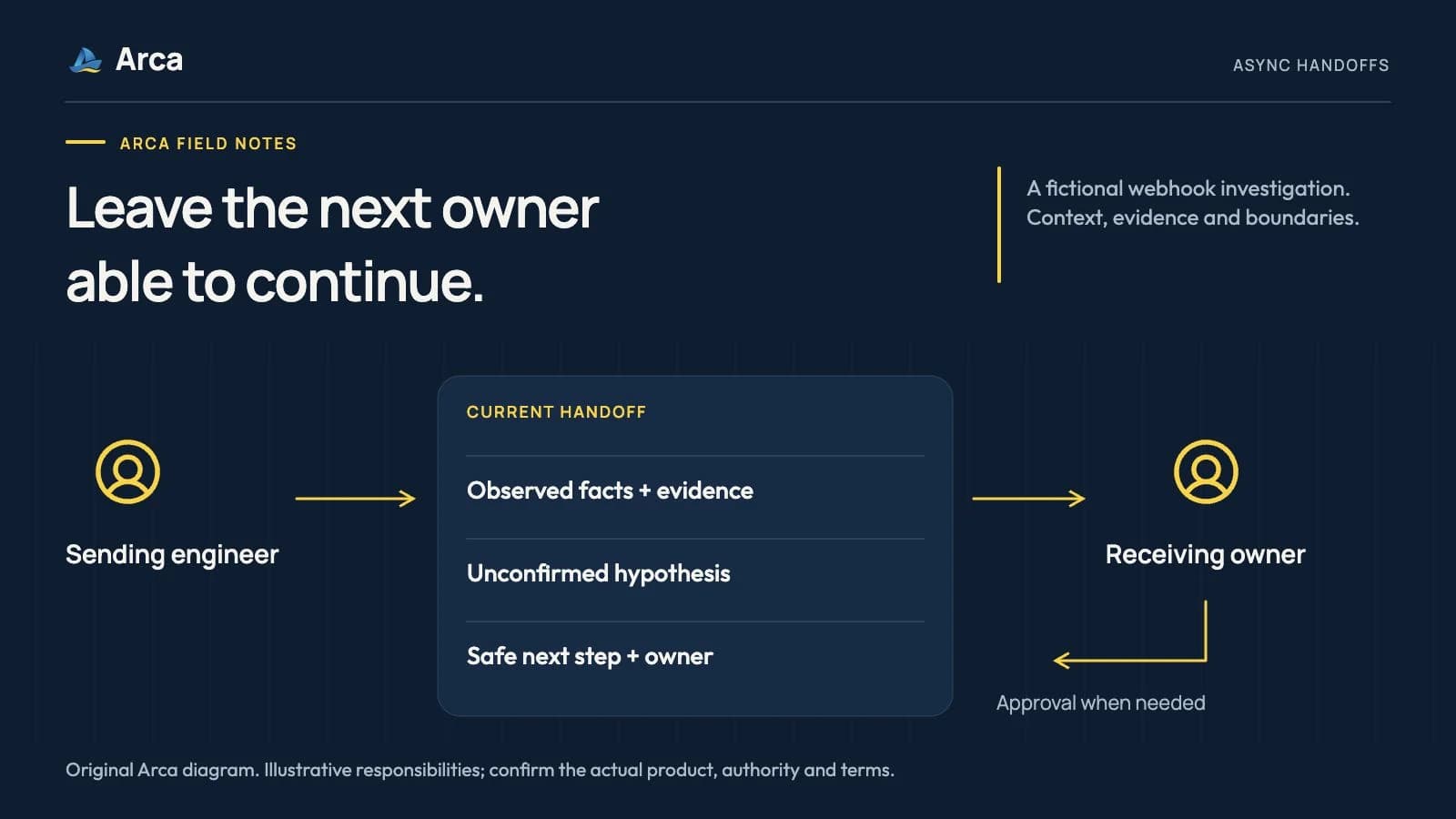
An asynchronous engineering handoff should leave the receiving person able to understand the current state, continue a safe next step and identify any decision that requires approval. It needs more than a progress update. It needs context, evidence, responsibility and boundaries.
For US–Philippines teams, agree actual working hours and response expectations first. The template below supports work between those windows; it does not create round-the-clock availability or authorize an engineer to act outside their permissions.
Write for the next decision
“Still investigating; will update tomorrow” reports activity but leaves the next person little to work with. Start with the issue and what the recipient needs to decide or do. Distinguish observed facts, proposed explanations and checks not yet performed.
Microsoft's asynchronous collaboration checklist recommends shared written context and captured decisions. Put the handoff alongside the work in your issue or review system, where authorized teammates can find it. Avoid spreading the operative version across several private messages.
A filled engineering handoff
This is an original fictional example. A synthetic webhook-delivery test shows repeated retries after a receiver responds slowly. No customer incident, real logs or actual Arca engagement is represented.
| Handoff field | Filled example |
|---|---|
| Work and receiving owner | Investigate repeated webhook retries in test; receiving engineer: the named API maintainer |
| Intended behavior | A slow receiver should produce an understandable delivery state under the agreed retry policy |
| Observed state | The synthetic receiver processed one event; the sender's test history shows three attempts |
| Evidence | Link to the approved test run, synthetic event ID and relevant sanitized log excerpt |
| Checks completed | Repeated the test with the supplied slow-response fixture; compared sender and receiver timestamps |
| Hypothesis | The sender may retry after a timeout even when the receiver processed the event; not yet confirmed |
| Safe next step | Inspect the timeout/retry path in the test repository and add a focused test of the uncertain outcome |
| Decision needed | Technical lead to confirm the intended retry behavior and whether a receiver-side duplicate guard is part of this assignment |
| Boundary | No production replay, queue purge or credential changes are authorized by this handoff |
| Response expectation | Agree a specific response window with a time zone and backup; if no answer, continue independent investigation only |
| Closure | Receiving owner acknowledges the next step, records new findings and links the eventual review/decision |
Replace every placeholder owner and link with the actual authorized person and resource. Do not paste a token, credential or customer payload into the handoff. A sanitized reference can point to restricted evidence without duplicating it in a broad channel.
Distinguish permission from a proposed next step
A sentence describing what might help is not an approval to perform it. Mark actions that change production, affect customers, spend money or alter access as decisions for the appropriate owner.
GitLab's directly responsible individual guidance makes accountability explicit while allowing consultation and additional approvals. In a small team, the handoff may need only a receiving engineer, a technical decision owner and the relevant approval route. Avoid adding a committee when one authorized person can resolve the issue.
In the webhook example, the receiver's duplicate-processing behavior may belong to another team. The sender's engineer can identify that dependency without claiming authority to change the other system. State the question and owner so the next person does not rediscover the boundary.
Keep review discussion useful after the call
When feedback changes the approach, update the work record with the reason and current decision. Google's code-review comment guidance emphasizes clear reasoning and useful explanations in the code or comments where appropriate. A decision left only in an old review thread can be difficult for the next maintainer to interpret.
Keep the handoff short by linking stable documentation and relevant evidence. Do not paste an entire transcript. The reader needs the current state, meaningful checks and remaining decision, rather than a minute-by-minute account of the previous shift.
If uncertainty cannot be resolved efficiently in writing, use an agreed live discussion and then capture the outcome. GitLab's communication handbook treats asynchronous and synchronous communication as tools for different needs. You can adapt that practice without copying its entire operating model.
Test whether another engineer can use it
Ask the receiving person to explain the next step using only the handoff and linked material. If they cannot access a link, identify the expected result or tell which action needs approval, repair the record.
Check the handoff at the next team review. Which questions repeated? Which findings were assumptions? Where did work wait for an unnamed owner? Improve the template around real gaps rather than adding fields after every minor variation.
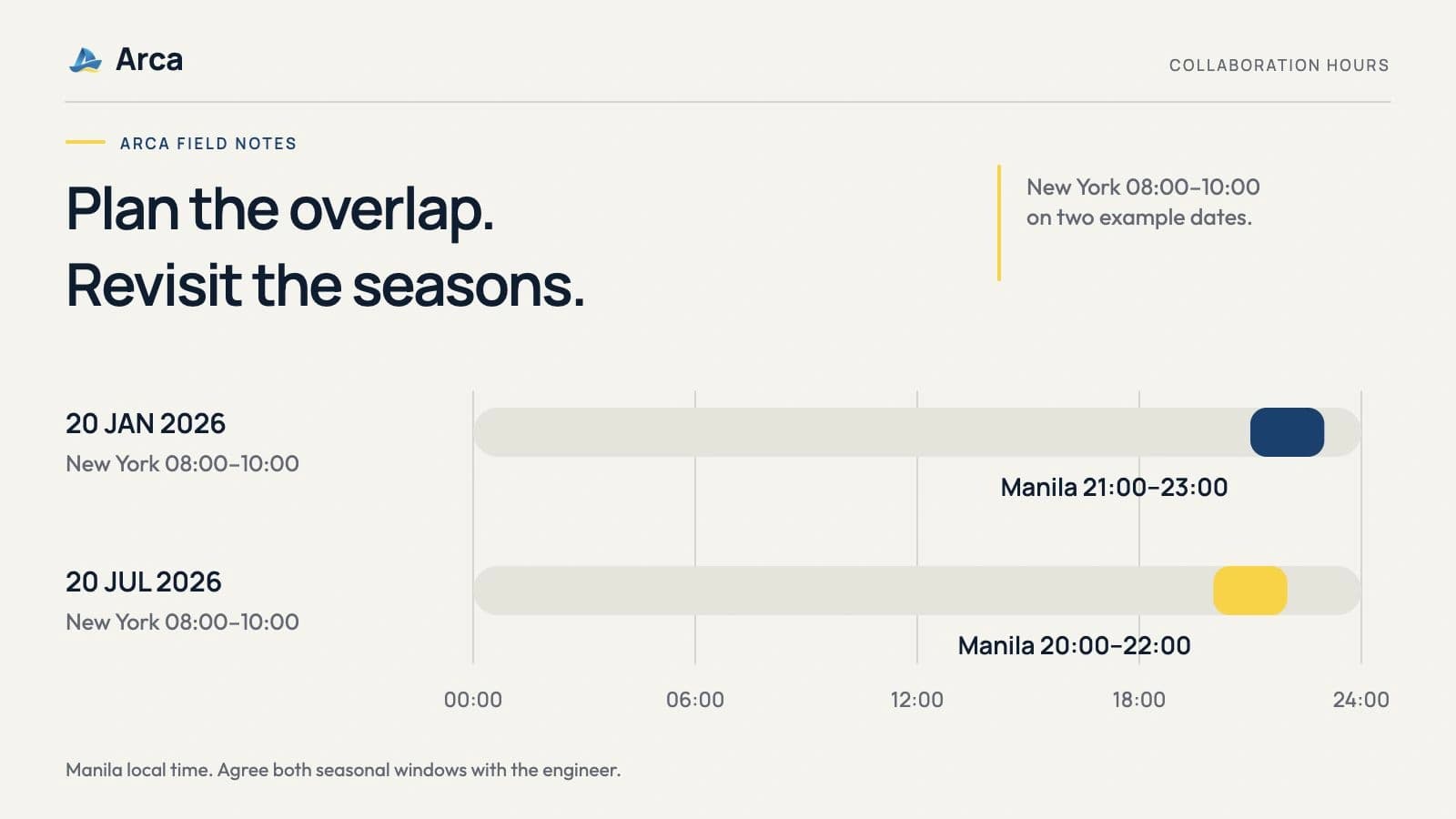
The US–Philippines working-hours guide owns the overlap schedule. The onboarding guide helps make this handoff routine part of a new engineer's introduction to the team.
Include handoffs in the engineering role
Tell candidates what written responsibility the job requires and show the format your team actually uses. A relevant assessment can ask someone to organize a synthetic investigation into a handoff, with scope and tools agreed in advance.
When discussing a Philippine engineering hire with Arca, bring the work, collaboration windows and review support alongside the stack. A clear handoff convention helps define the role; it does not replace technical judgment, permissions or a working agreement.
Frequently asked questions
How is a handoff different from a status update?
A handoff enables another person to continue safely. It includes relevant evidence, the next action, receiving owner and decisions or permissions still required.
Does a handoff authorize production changes?
No. Identify the appropriate approver and follow the actual permission process. A proposed next step is not automatic authorization.
Where should the handoff live?
Keep the current record alongside the work in an approved shared issue or review system. Link restricted evidence without exposing secrets or customer data.
When should the team use a live conversation?
Use agreed live time when writing is not resolving the uncertainty or urgent coordination is required. Record the resulting decision for colleagues who were absent.
Does this create around-the-clock coverage?
No. Agree actual work windows, response expectations and backup arrangements. Time-zone differences alone do not establish continuous availability.